
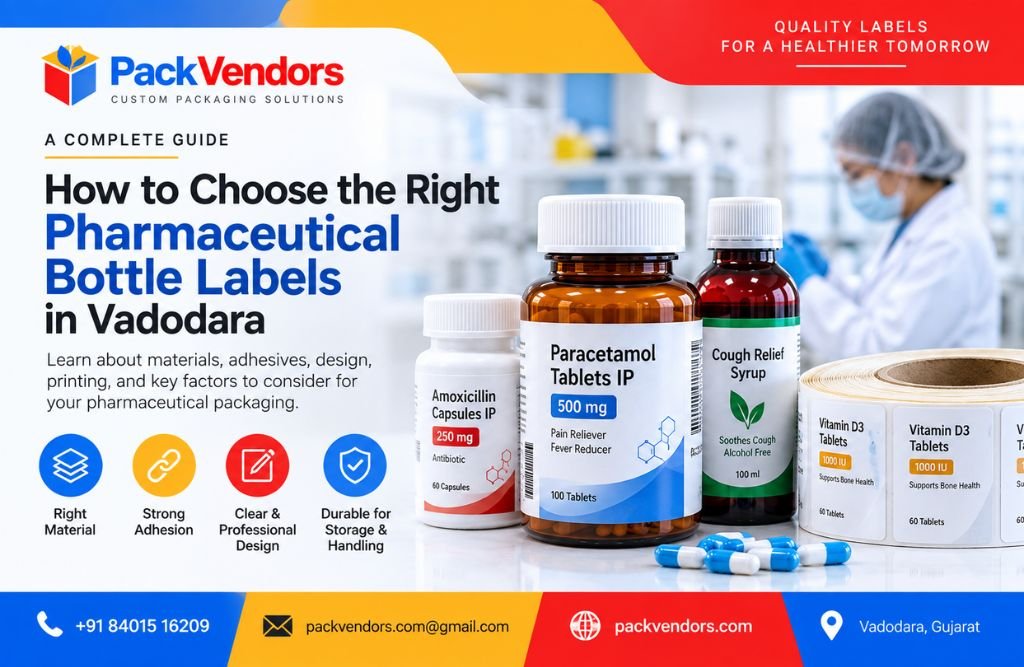
A pharmaceutical bottle label has a demanding job. It needs to present important product information clearly while staying securely attached to the bottle during storage, transportation, handling, and everyday use. At the same time, the label should look professional and maintain a consistent appearance across your product range.
For pharmaceutical manufacturers, contract manufacturers, healthcare product companies, and packaging businesses, choosing the right pharmaceutical bottle labels in Vadodara is therefore not simply a matter of selecting a design. The bottle material, label size, adhesive, printing method, finish, and application process all need to work together.
This guide explains the key factors to consider before ordering pharmaceutical bottle labels and how to make a more informed choice for your packaging.
What Makes Pharmaceutical Bottle Labels Different?
Pharmaceutical labels are often expected to carry more information than a typical product sticker. Depending on the product and applicable requirements, a label may contain the product name, strength, dosage information, batch details, manufacturing information, expiry information, warnings, barcodes, and other relevant details.
Because of this, readability and accuracy are extremely important.
The label should provide enough space for the required information without making the design feel overcrowded. Text, numbers, symbols, and machine-readable codes should remain clear after printing.
A good pharmaceutical label should balance three things:
- Clear and organized information
- Reliable adhesion and durability
- A professional, consistent appearance
Start With the Bottle Surface
Before selecting a label material, look at the bottle itself.
Pharmaceutical bottles can be made from glass or different types of plastic. Some have smooth cylindrical surfaces, while others may have curves, grooves, shoulders, or other shapes.
The surface can influence how the label performs.
For example, a label designed for a smooth glass bottle may not behave exactly the same way on a curved plastic container. The adhesive and label material may need to be selected differently depending on the surface.
When speaking with your label printer, provide:
- Bottle material
- Bottle shape
- Bottle dimensions
- Labeling area
- Surface characteristics
- Storage conditions
- Application method
If possible, provide a physical bottle sample or clear photographs. This gives the printer a better understanding of the actual application.
How to Choose the Right Label Material
Material selection should be based on how the bottle will be stored and handled, not simply on how the label looks.
Paper-Based Labels
Paper-based materials can be suitable for pharmaceutical packaging used in controlled environments. They can provide a clean printed appearance and may be appropriate where exposure to moisture is limited.
However, paper is not automatically suitable for every application. If the bottle will be exposed to condensation, refrigeration, or frequent handling, discuss other options with your printer.
Synthetic Labels
Synthetic materials may provide greater resistance to moisture and handling. They can be considered when the label needs additional durability.
The appropriate synthetic material depends on the application, bottle surface, and expected environmental conditions.
Transparent Labels
Transparent materials can provide a clean, minimal appearance by allowing part of the bottle surface to remain visible. They may be suitable for certain products where a less traditional label appearance is preferred.
For pharmaceutical bottle labels in Vadodara, the best material is the one that suits the bottle and its actual working conditions.
Don’t Overlook the Adhesive
A label can have excellent printing quality and still fail if the adhesive is not appropriate.
The adhesive needs to work with the bottle surface and remain reliable under the conditions the product will experience.
Consider whether the bottle may be exposed to:
- Moisture or condensation
- Refrigeration
- Temperature changes
- Frequent handling
- Transportation vibration
- Different storage environments
Poor adhesive selection can lead to lifting corners, peeling, wrinkling, or label movement.
This is why it is useful to tell your printer exactly where and how the finished bottles will be stored and handled.
Choose the Correct Label Size and Shape
The label dimensions should be confirmed before the artwork is finalized.
A label that is too large may create wrinkles or overlap when applied to a curved bottle. A label that is too small may not provide enough space for required product information.
For cylindrical bottles, consider the available height and circumference of the labeling area. Also check whether the label needs to wrap around the entire bottle or cover only a specific section.
Common options include:
- Rectangle
- Square
- Round
- Oval
- Custom shapes
The shape should work with both the bottle and the labeling process.
Design for Readability First
Pharmaceutical packaging often contains detailed information, so the design should prioritize readability.
A visually attractive label is useful, but customers and professionals need to find important information quickly.
Use a Clear Information Hierarchy
The product name should be easy to identify. Other information can then be organized into logical sections.
Choose Readable Fonts
Avoid fonts that look decorative but become difficult to read at smaller sizes.
Use Good Contrast
Text should stand out clearly from the background. Poor contrast can make small information difficult to read.
Leave Enough White Space
White space is not wasted space. It helps separate different pieces of information and prevents the label from looking overcrowded.
Maintain Brand Consistency
If you have several pharmaceutical products, using a consistent visual style can make your product range look organized while still allowing each product to have its own identity.
Barcode and QR Code Printing
Many pharmaceutical products may require barcodes, QR codes, or other machine-readable elements depending on their purpose and applicable requirements.
These elements need sufficient space and should be reproduced clearly during printing.
Before approving a large order, check that:
- The barcode or QR code is positioned correctly
- It has adequate clear space around it
- The printed code is sharp
- The dimensions are correct
- The final printed version can be scanned where required
Do not treat a barcode as just another graphic element in the artwork. Its functionality matters.
Labels for Manual or Automatic Application
How the label will be applied is another important consideration.
Some businesses apply labels manually, while larger production operations may use automatic labeling equipment.
If your bottles are labeled by machine, your printer may need specific roll specifications. These can include details such as:
- Roll direction
- Core size
- Roll diameter
- Label spacing
- Label orientation
- Quantity per roll
The exact requirements depend on the labeling equipment.
Tell your printer about the application method before production begins. A label that looks correct on screen may still need adjustments to work properly with an automatic labeling machine.
Choosing the Right Label Finish
The finish can influence both appearance and performance.
Matte Finish
A matte surface can create a clean and understated appearance and may reduce glare in some situations.
Gloss Finish
Gloss can provide a brighter appearance and may make colours appear more vibrant.
Protective Finishes
Depending on the material and application, protective finishing may be considered when additional resistance is needed.
The best finish depends on your product, packaging environment, design, and practical requirements. It is better to select a finish based on the application rather than choosing one simply because it looks attractive.
What Information Should You Provide to Your Label Printer?
Providing complete specifications can save time and reduce the possibility of errors.
Before requesting a quotation, prepare:
Bottle details: Material, shape, size, and photographs or sample if available.
Label dimensions: Width, height, shape, and placement.
Material requirements: Paper, synthetic, transparent, or another suitable option.
Adhesive requirements: Based on the bottle surface and storage conditions.
Printing requirements: Colours, artwork, and any special elements.
Barcode or QR code: If required.
Application method: Manual or automatic.
Quantity: Number of labels required.
Finish: Matte, gloss, laminate, or another suitable option.
For pharmaceutical bottle labels in Vadodara, having these details ready can make it easier for the printer to understand the project and recommend suitable options.
What Affects Pharmaceutical Bottle Label Printing Cost?
There is no single price for custom pharmaceutical labels. The final cost can depend on several factors.
Quantity
The number of labels required can influence production costs. Small and large orders may have different pricing structures.
Label Size
Larger labels generally require more material.
Material
Specialized or synthetic materials may have different costs from standard paper-based materials.
Printing Requirements
Colour requirements, artwork complexity, and production specifications can influence the price.
Shape and Cutting
Custom shapes may require additional cutting arrangements compared with standard shapes.
Finish
Special finishes or protective treatments can add to the production cost.
When comparing quotations, don’t look only at the price per label. Consider whether the material, adhesive, printing quality, and production format are suitable for your application.
Should You Request a Sample Before a Large Order?
For a new pharmaceutical label, a sample or proof can be extremely useful.
It gives you an opportunity to check the label on the actual bottle before committing to a larger quantity.
Look at:
- Label fit
- Text readability
- Colour accuracy
- Adhesion
- Barcode or QR code
- Overall appearance
- Application performance
A sample can reveal problems that are difficult to identify from a digital artwork file alone.
How to Order Pharmaceutical Bottle Labels
Once your requirements are ready, the ordering process can be straightforward.
Step 1: Provide Bottle Details
Share the bottle dimensions, material, shape, and intended application.
Step 2: Confirm Label Specifications
Finalize the size, shape, material, adhesive, and finish.
Step 3: Submit Your Artwork
Provide your logo, product information, regulatory text, barcode, QR code, or other required artwork.
Step 4: Review the Proof
Carefully check all text, numbers, dimensions, colours, and machine-readable elements.
Step 5: Test the Sample
Where appropriate, check the label on the actual bottle and confirm that it performs as expected.
Step 6: Approve Production
Once the specifications and artwork are confirmed, approve the final quantity and production requirements.
Pharmaceutical Bottle Label Checklist
Before approving your order, ask yourself:
- Does the label fit the bottle correctly?
- Is the material suitable for the bottle surface?
- Is the adhesive appropriate for storage conditions?
- Is all important information readable?
- Have spelling and numbers been checked?
- Are barcode and QR code details correct?
- Is the finish appropriate?
- Will the labels be applied manually or by machine?
- If using a machine, have roll specifications been confirmed?
- Have you reviewed a sample or final proof?
This simple checklist can help prevent avoidable mistakes before production.
Frequently Asked Questions
What is the best material for pharmaceutical bottle labels?
There is no universal material for every pharmaceutical product. The choice depends on the bottle surface, storage conditions, moisture exposure, durability requirements, and labeling process.
Can pharmaceutical labels be made in custom sizes?
Yes, labels can generally be produced according to the available labeling area of the bottle. Accurate measurements are important before finalizing the artwork.
Can I include a barcode or QR code?
Yes, where required, these elements can be incorporated into the label design. They should be given adequate space and printed clearly enough for their intended use.
Can labels be supplied on rolls?
Roll labels can be suitable for automatic labeling systems. The printer may need specific information about the labeling machine and roll configuration.
Can I use my own label design?
Yes, you can generally provide your own artwork. Your printer can advise you about suitable file formats and artwork specifications.
How can I get an accurate quotation?
Provide the bottle size, label dimensions, quantity, material preference, artwork, finish, and application method. More complete information generally makes it easier to prepare an accurate quotation.
Choose Labels Based on Performance, Not Just Appearance
The right pharmaceutical bottle label should look professional, but appearance is only one part of the decision. Material, adhesive, dimensions, printing quality, barcode readability, storage conditions, and application method all deserve attention.
If you are searching for pharmaceutical bottle labels in Vadodara, start with the bottle and its real-world requirements. Once those details are clear, you can choose a label material and design that fits the product rather than trying to make the product fit the label.
A carefully planned label can help create cleaner packaging, more consistent products, and fewer problems during application and handling.
Before placing your order, prepare your bottle specifications, label dimensions, quantity, artwork, and application requirements. Then discuss the project with a professional label printer to determine the most suitable combination of material, adhesive, printing, and finishing.