
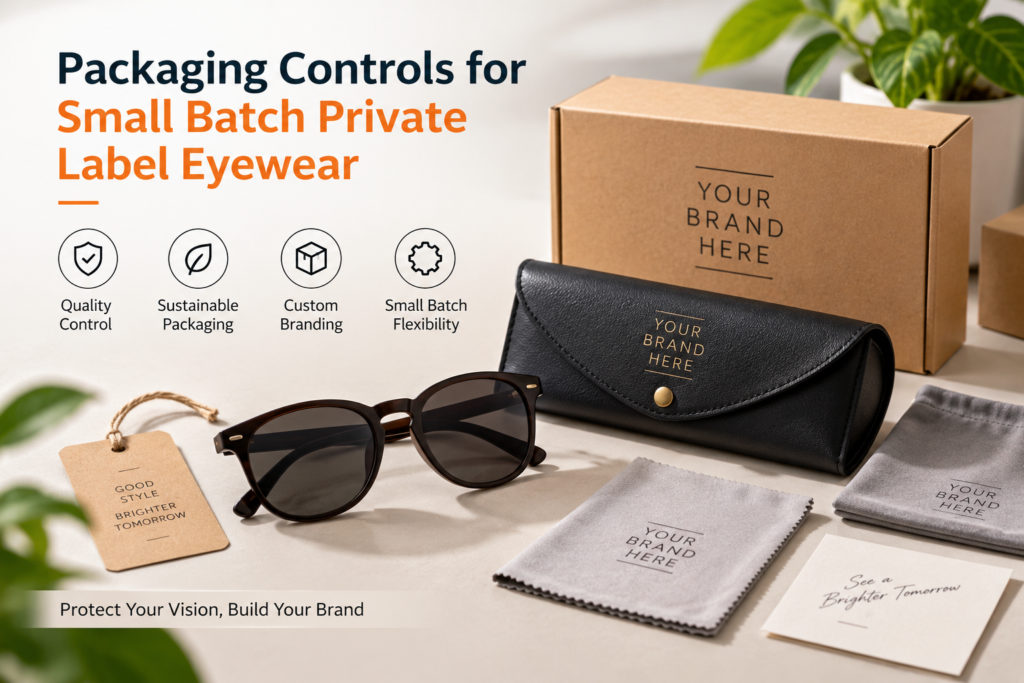
Eyewear packaging has to perform several jobs at once. It protects frames during handling, supports the brand experience, fits the selling channel, and gives the warehouse a repeatable packing instruction. Those requirements become harder to manage when a private-label program includes several frame shapes, colorways, or destination markets. A small order does not remove the need for control; it makes clear records even more valuable because there is less room to absorb a wrong sample or a mixed carton.
Start with the handling scenario
Before choosing a box, case, pouch, or insert, define how the finished unit will move. A package intended for a showroom does not face the same conditions as one shipped through a parcel network. A gift set may prioritise presentation, while a replenishment order may prioritise compact storage and quick packing. The same frame can require a different outer configuration when it is sold individually, packed in a multi-unit carton, or sent to a distributor for later repacking.
Write the intended handling scenario in plain language. Include whether the package is for retail display, direct-to-consumer shipping, wholesale delivery, event sampling, or more than one use. This short statement gives the packaging discussion a purpose and helps the team compare options on protection, volume, assembly time, and presentation instead of comparing photographs alone.
Build a packaging record for each sellable combination
The most common source of confusion is a broad instruction such as “use the standard set.” A buyer may consider several colourways part of one style, while the supplier may need different labels, inserts, or carton marks for each combination. Give every sellable combination a line in a shared record, even when most of the fields are identical.
Useful fields include the buyer SKU, supplier model reference, frame colourway, lens description, logo artwork version, case or pouch reference, insert language, barcode status, target quantity, and approval status. Add the destination market when it affects labels or care information. If two versions use the same case but different inserts, keep them as separate lines and link them to the same component reference. This preserves traceability without forcing the team to duplicate every specification.
Check physical fit before cosmetic approval
Digital artwork cannot answer whether a frame fits comfortably inside the finished package. Eyewear varies in temple length, lens width, bridge shape, hinge construction, and the space required by a cloth or insert. A case that looks correct on a screen can press against the front of a larger frame, or leave enough movement for a smaller frame to shift during handling.
Ask for a physical fit check using representative extremes from the range. The smallest and largest planned frames are useful starting points, but unusual shapes and longer temples may also need separate checks. Record whether the frame closes without pressure, whether the lens surface is protected, whether accessories move inside the case, and whether the finished unit can be removed without damaging the presentation.
Functional and cosmetic approvals should be recorded separately. Functional approval covers fit, closure, protection, packing sequence, and handling. Cosmetic approval covers colour, texture, print, foil, embossing, logo placement, and the appearance of the assembled set. Separating the decisions means that a cosmetic revision does not accidentally reopen a functional approval that has already passed.
Treat artwork as a controlled production file
Packaging artwork often travels through email as screenshots, PDFs, and renamed attachments. That makes it easy for an older version to return to the production conversation. Each approved component should therefore carry a simple version number or date, and the same identifier should appear in the packaging record and purchase-order notes.
Keep the previous version when a change is made. Add a short reason for the revision, such as a language update, a new barcode, a carton-quantity change, or a correction to logo position. Do not rely on a file’s modified timestamp as the only record. A small revision history helps the buyer and supplier answer which proof was approved, which sample was checked, and which instruction was released for production.
Make sustainability specific enough to verify
Sustainability language is useful only when the packaging specification makes it testable. Instead of recording a general request for eco-friendly packaging, identify the material and the relevant construction details. Depending on the package, this may include recycled content, paper weight, coating, adhesive, lining, hardware, printing process, and whether mixed materials can be separated at end of life.
The right choice depends on the complete system. A paper component may be recyclable in isolation but difficult to process when bonded to a synthetic lining or metal decoration. A lighter package may reduce material use but need additional protection in transit. Procurement teams do not need to make a universal environmental claim; they need a clear description of what is being supplied and what still requires confirmation for the destination market.
Reconcile the package with the order before release
The final packaging check should compare the product matrix, approved physical sample, artwork files, packing instruction, and purchase order. Check the model, colourway, accessories, component versions, quantity, and carton configuration line by line. Any mismatch should have an owner and a visible status such as HOLD, REVISE, or APPROVED FOR PO.
This is also the right stage to keep unresolved items visible. Material descriptions, coatings, testing, certifications, minimum order quantities, prices, and delivery dates are project-specific. They should be confirmed for the selected frame range and destination rather than inferred from an older order or a general category page. A controlled record prevents an open question from becoming an accidental production commitment.
For a practical example of connecting style, colourway, and order information, buyers can use the eyewear SKU and colorway matrix as a planning reference. It is a coordination aid, not a substitute for approving the selected project’s own measurements, materials, or compliance requirements.
Give the warehouse a short, usable instruction
The people packing the finished units should not have to reconstruct a decision from a long email thread. Convert the approved record into a concise packing instruction that names the sequence: frame preparation, protective layer, case or pouch, insert, cloth, retail carton, label, and outer-carton arrangement. Show exceptions by SKU or colourway rather than burying them in prose.
If the program is small, a clear one-page sheet may be enough. If it changes frequently, retain the same fields in a shared matrix and issue a dated release version. In either format, include the sample reference, the artwork version, the quantity per carton, and the person responsible for approving a change. These details make receiving checks faster and reduce the chance that two valid-looking versions will be packed in the same shipment.
Small-batch private-label eyewear does not need an elaborate packaging system. It needs a consistent chain from selling combination to physical fit, artwork revision, purchase-order release, and warehouse instruction. When each step is recorded in the same language, buyers and suppliers can change a style or package without losing track of what was actually approved.