
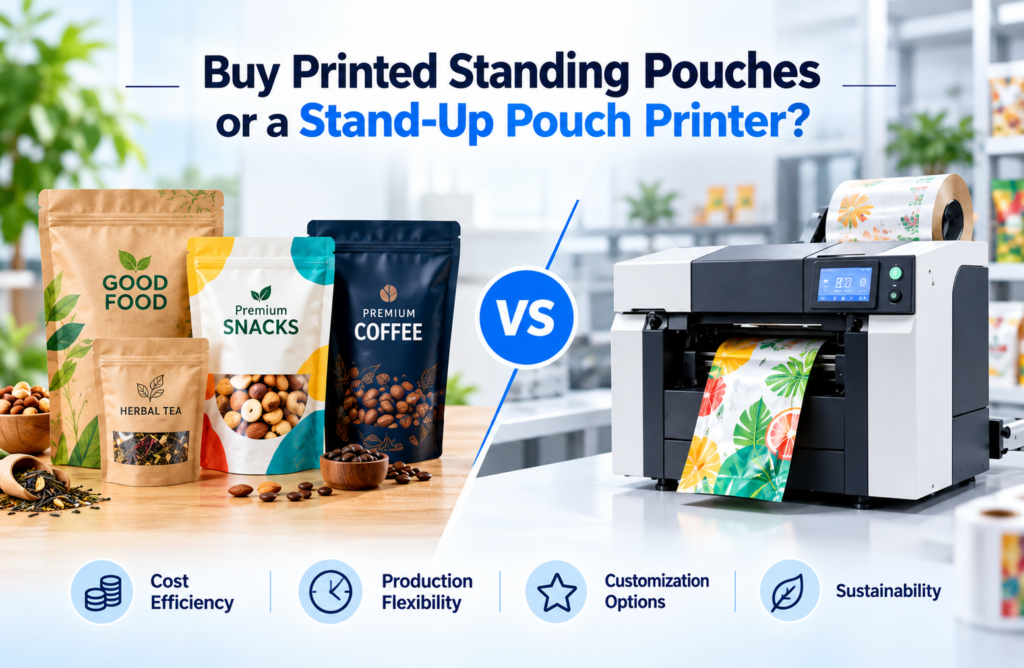
Stand-up pouches have become a popular packaging choice across the food, cosmetics, pet care, and consumer goods industries. Their lightweight structure, convenient storage, and flexible branding options make them suitable for businesses of different sizes.
However, companies planning to introduce customised pouch packaging often face an important decision: Should they purchase pre-printed stand-up pouches from a packaging supplier or invest in a stand up pouch printer for in-house production?
Both approaches have advantages. The right choice depends on production volume, packaging requirements, design flexibility, and long-term operating costs.
This guide compares the two options and explains when investing in a pouch printing machine may be more practical than outsourcing printed packaging.
What Are Printed Stand-Up Pouches?
Printed stand-up pouches are flexible packaging bags designed to stand upright when filled. They typically feature a bottom gusset that provides stability, making them convenient for retail display and product storage.
These pouches can be manufactured from various materials, including plastic films, laminated composites, aluminium foil laminates, and kraft paper structures.
Common applications include:
Coffee beans, tea, and powdered beverages
Snacks, dried fruits, and confectionery
Pet food and nutritional products
Cosmetics and personal care items
Household products and specialty goods
Promotional merchandise and gift packaging
Depending on the packaging structure, stand-up pouches may incorporate resealable zippers, tear notches, transparent windows, and other functional features.
Businesses can purchase printed pouches directly from packaging manufacturers or use suitable printing equipment to add designs, logos, variable information, and decorative elements to compatible pouch surfaces.
Option 1: Buying Pre-Printed Stand-Up Pouches
Purchasing pre-printed pouches is a common approach for established brands and businesses with predictable packaging requirements.
Packaging suppliers typically handle material selection, artwork preparation, printing, lamination, pouch forming, and quality inspection.
Advantages of Buying Printed Pouches
- Suitable for large production volumes
Businesses requiring thousands of identical packages can benefit from established industrial printing processes.
Flexographic and rotogravure printing are commonly used for high-volume flexible packaging production, offering consistent results across large batches.
- Professional full-colour printing
Packaging manufacturers can produce detailed graphics, gradients, photographic images, and complex brand designs.
This is particularly useful for retail products where packaging appearance plays an important role in attracting customers.
- No equipment investment
Outsourcing eliminates the need to purchase printing machinery, train operators, or maintain an internal printing process.
Companies can focus on product development, distribution, and marketing instead.
Disadvantages of Buying Printed Pouches
Despite these benefits, outsourced printing may create challenges for businesses requiring frequent packaging changes.
Minimum order quantities: Some packaging suppliers require relatively large orders, particularly for conventional printing processes.
Longer turnaround times: Artwork approval, production scheduling, printing, and transportation can extend delivery times.
Inventory pressure: Ordering large quantities of packaging increases storage requirements and the risk of unused inventory.
Limited design flexibility: Changing artwork, promotional messages, or product information may require a new production order.
These limitations are especially relevant to startups, seasonal brands, and businesses introducing multiple product variations.
Option 2: Investing in a Stand-Up Pouch Printer
An alternative is to purchase a standup pouch printing machine and perform suitable printing operations in-house.
Depending on the equipment and printing technology, businesses may print logos, text, decorative designs, product identifiers, or variable information onto compatible pouch materials.
For companies requiring frequent design changes or relatively small production runs, this approach offers greater operational control.
Advantages of In-House Pouch Printing
- Greater flexibility for small batches
One of the main advantages of owning printing equipment is the ability to produce packaging according to actual demand.
With a suitable machine, small batch pouch printing allows businesses to prepare limited quantities without committing to large outsourced orders.
This is useful for product testing, seasonal promotions, personalised packaging, and limited-edition products.
- Faster design changes
In-house printing allows operators to adjust compatible artwork or printing content without repeatedly placing orders with external suppliers.
Businesses can respond more quickly to changing market requirements.
- Reduced dependence on packaging suppliers
Companies can maintain greater control over production schedules and reduce their reliance on external printing services.
However, they may still need to purchase suitable blank or partially printed pouches.
- More opportunities for customisation
A compatible stand up pouch printer can support applications such as personalised gift packaging, product identification, promotional graphics, and decorative finishing.
The available functions depend on the machine’s printing technology, software, print area, and supported materials.
Printed Stand-Up Pouches vs. Pouch Printing Machines
Before deciding between outsourced packaging and in-house printing, businesses should evaluate their production requirements.
| Comparison | Buying Printed Stand-Up Pouches | Purchasing a Pouch Printing Machine |
| Initial investment | Generally lower | Equipment purchase required |
| Large-volume production | Often more economical | Depends on machine capacity |
| Small-batch production | May involve higher unit costs | Potentially more flexible |
| Design changes | Usually require supplier coordination | Can be handled internally |
| Production lead time | Depends on supplier scheduling | Depends on internal capacity |
| Inventory requirements | May require bulk storage | Can reduce printed inventory |
| Printing capabilities | Broad range of industrial processes | Limited to selected equipment |
| Maintenance | Managed by supplier | Managed by equipment owner |
| Customisation | Subject to supplier capabilities | Depends on machine specifications |
Neither option is universally better.
Businesses producing large quantities of identical, fully printed retail packaging may find outsourcing more economical. Companies requiring frequent changes, personalised designs, or short production runs may benefit from investing in suitable equipment.
When Does Small Batch Pouch Printing Make Sense?
Small batch pouch printing is particularly valuable when packaging demand is unpredictable or product designs change frequently.
For example, a specialty coffee company may offer several coffee varieties, each requiring different product information. Purchasing thousands of fully printed pouches for every variety could create unnecessary inventory.
Alternatively, the company could purchase compatible blank or partially printed pouches and add selected information internally.
Other suitable scenarios include:
New product launches and market testing
Seasonal packaging and promotional campaigns
Personalised gifts and premium packaging
Multiple product variations with limited demand
Short-run decorative printing
Packaging prototypes and sample development
However, companies should distinguish between printing an entire full-colour pouch design and adding selected information or decorative finishes.
Different printing technologies serve different purposes, and not every machine can perform both operations.
How to Choose a Suitable Standup Pouch Printing Machine
Selecting the right equipment requires more than comparing machine prices.
Businesses should consider the following factors.
1. Printing Technology
Different technologies support different applications.
Digital inkjet systems can be suitable for variable graphics and short-run colour printing, provided the inks and substrates are compatible.
Thermal transfer systems are commonly used for durable text, barcodes, and variable information on suitable materials.
Digital hot foil printing equipment, meanwhile, is designed for decorative metallic finishes rather than conventional full-colour graphics.
2. Material Compatibility
Stand-up pouches are manufactured from materials with different surface properties.
Before purchasing equipment, confirm whether the machine supports the intended pouch material, coating, thickness, and surface finish.
Printing performance on kraft paper may differ significantly from printing on smooth laminated films.
3. Printing Area and Pouch Dimensions
The machine must accommodate the dimensions of the pouch and the intended printing position.
Businesses should also consider whether the equipment can handle pre-formed pouches, including those with gussets, zippers, or uneven surfaces.
4. Production Speed and Operating Costs
Evaluate printing speed, consumable expenses, maintenance requirements, operator involvement, and expected daily output.
A lower equipment price does not necessarily mean a lower total production cost.
5. Customisation and Technical Support
For industrial users, equipment adaptability can be particularly important.
Businesses may require customised fixtures, printing software, mechanical structures, or integration with existing packaging workflows.
Working directly with an equipment manufacturer can help address these requirements during machine selection.
Conclusion: Which Option Is Right for Your Business?
Choosing between buying printed stand-up pouches and investing in a stand up pouch printer depends on production volume, artwork requirements, material compatibility, and budget.
For businesses producing large quantities of identical packaging, purchasing pre-printed pouches from a professional supplier remains a practical option.
For companies requiring frequent design changes, personalised packaging, or small production runs, investing in suitable printing equipment may provide greater flexibility.