
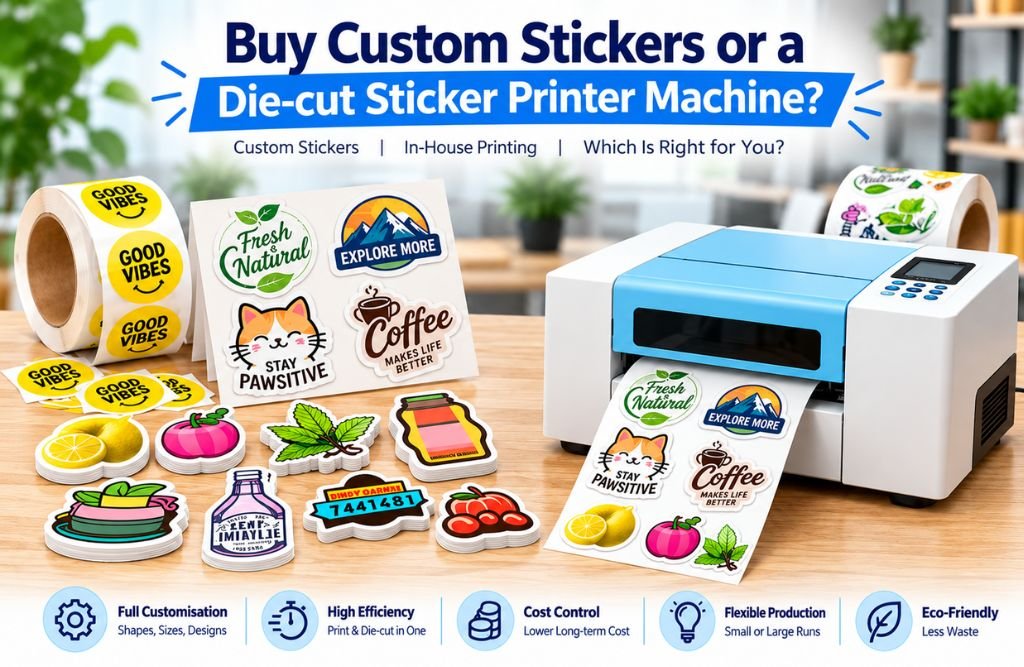
Custom stickers are widely used for product identification, branding, safety warnings, equipment labelling, and promotional purposes. From small businesses ordering personalised stickers to industrial manufacturers requiring durable identification labels, the demand for customised sticker printing continues to create opportunities for both printing service providers and equipment manufacturers.
However, businesses often face a practical question: Is it better to buy custom stickers from a printing supplier or invest in a die-cut sticker printer machine for in-house production?
Both options have advantages. Purchasing ready-made stickers eliminates equipment investment, while owning a sticker printing and cutting machine provides greater control over production schedules, customisation, and inventory.
This article compares their costs, flexibility, and production capabilities to help businesses determine which approach best suits their requirements.
What Are Custom Die-Cut Stickers?
Die-cut stickers are adhesive labels cut into specific shapes rather than standard rectangular or circular formats. Their outlines may follow a logo, symbol, lettering, or other customised design.
Unlike conventional stickers supplied in fixed dimensions, die-cut stickers offer greater freedom in appearance and application.
Common applications include:
Product branding: Custom logos, packaging labels, and promotional stickers.
Industrial identification: Equipment labels, electrical cabinet markings, and machine identification.
Safety signage: Warning symbols, hazard labels, and instructional markings.
Retail and logistics: Product identification, inventory labels, and warehouse markings.
Outdoor applications: Garden labels, plant identification, and weather-resistant signage.
Depending on the material and printing technology, die-cut stickers can be manufactured from paper, vinyl, PVC, PET, and other adhesive substrates.
For businesses requiring customised shapes, a suitable die cut sticker printer machine can combine printing and automated contour cutting within one production workflow.
Option 1: Buying Custom Stickers from a Printing Supplier
Ordering custom stickers from a professional printing company is a straightforward solution, particularly for businesses without dedicated printing facilities.
Customers generally submit their artwork, select materials and dimensions, specify quantities, and receive finished stickers after production.
Advantages of Buying Custom Stickers
- No equipment investment
Outsourcing eliminates the need to purchase printing machinery, cutting equipment, or specialised software.
This approach is especially suitable for startups and companies with occasional sticker requirements.
- Access to different printing technologies
Professional printing suppliers may offer full-colour digital printing, screen printing, UV printing, and various finishing options.
Businesses can select different materials, adhesives, laminates, and surface finishes without maintaining multiple machines.
- Suitable for large-volume orders
When thousands of identical stickers are required, established printing suppliers may offer competitive unit prices through efficient batch production.
- Reduced operational responsibility
The supplier manages production, machine maintenance, quality inspection, and material procurement.
Limitations of Outsourcing Custom Stickers
Although convenient, outsourcing also introduces several challenges.
Minimum order quantities: Some suppliers require minimum quantities for customised shapes or specialised materials.
Production lead times: Artwork approval, printing, cutting, packaging, and shipping can delay delivery.
Limited flexibility: Frequent changes to sticker dimensions, text, or designs may require additional orders.
Inventory requirements: Purchasing large quantities can create storage costs and increase the risk of obsolete labels.
These limitations become more noticeable when businesses require multiple sticker variations or frequent updates to product information.
Option 2: Investing in a Die-Cut Sticker Printer Machine
A die-cut sticker printer machine enables businesses to produce customised stickers internally rather than relying entirely on external suppliers.
Depending on the machine’s capabilities, printing and cutting can be integrated into one workflow, reducing the need for separate manual trimming operations.
Advantages of In-House Sticker Printing
- Greater production flexibility
Businesses can produce stickers according to actual demand instead of purchasing large quantities in advance.
This is particularly useful for short production runs, customised industrial labels, and frequently changing designs.
- Faster turnaround
With suitable materials and equipment available, operators can produce stickers without waiting for external printing suppliers.
This can be valuable for manufacturing facilities requiring urgent replacement labels or updated safety markings.
- Automated cutting
Traditional sticker production may involve separate printing and cutting processes.
An integrated sticker printing and cutting machine can simplify production by automatically cutting specified shapes or outlines after printing.
- Better control over customisation
Businesses can adjust sticker content, dimensions, and cutting patterns to accommodate different applications.
For industrial users, this flexibility is particularly useful when producing equipment identification labels, electrical warning signs, or customised nameplates.
- Potential long-term cost savings
Although purchasing equipment requires an initial investment, in-house production may reduce outsourcing expenses for companies with consistent sticker demand.
Actual savings depend on production volume, material costs, labour, equipment maintenance, and machine utilisation.
Buying Custom Stickers vs. Purchasing a Custom Sticker Printer
The following comparison highlights the differences between the two approaches.
| Comparison | Buying Custom Stickers | Die-Cut Sticker Printer Machine |
| Initial investment | Low | Higher |
| Production control | Supplier-dependent | In-house |
| Small-batch orders | May involve minimum quantities | Flexible |
| Design modifications | Require supplier coordination | Can be handled internally |
| Production lead time | Includes supplier processing and delivery | Depends on internal workflow |
| Custom shapes | Available through supplier | Depends on cutting capabilities |
| Equipment maintenance | Supplier responsibility | Buyer responsibility |
| Inventory requirements | May require bulk purchasing | Supports demand-based production |
| Long-term costs | Recurring outsourcing expenses | Equipment, consumables, and operating costs |
For companies requiring occasional promotional stickers, outsourcing is often the simplest choice.
However, businesses producing customised labels regularly may benefit from investing in a suitable printer with automatic cutting capabilities.
What Should You Consider Before Buying a Die-Cut Sticker Printer?
Not all sticker printers are designed for the same applications. Selecting the right equipment requires careful evaluation of several factors.
1. Printing Technology
Sticker printers use different printing methods, including inkjet, laser, and thermal transfer printing.
Inkjet printers are commonly used for colourful graphics and promotional stickers.
Thermal transfer printers use ribbons to transfer images onto compatible materials and are widely used for industrial labels, identification markings, and durable signage.
The appropriate technology depends on the desired print quality, colour requirements, material compatibility, and operating environment.
2. Cutting Accuracy
Cutting precision is important when producing customised shapes, especially stickers containing small text, intricate outlines, or detailed borders.
A machine with automated cutting and accurate positioning can help reduce manual processing and improve consistency.
3. Supported Materials
Different applications require different sticker materials.
For example, paper stickers may be suitable for indoor promotional use, while compatible PVC or PET adhesive materials may be preferred for certain industrial identification applications.
Always confirm the printer’s supported material types, thicknesses, and adhesive constructions before purchasing.
4. Printing Width and Production Speed
Businesses should consider their maximum sticker dimensions and expected daily output.
A printer designed for narrow barcode labels may not accommodate larger industrial safety signs or equipment markings.
Similarly, higher printing speeds are not always necessary for businesses prioritising customised, low-volume production.
5. Software and Connectivity
User-friendly software, convenient connectivity, and reliable positioning systems can improve production efficiency.
For businesses with specialised workflows, equipment customisation and technical support may also influence purchasing decisions.
Masung MS-TTR370 Die-Cut Sticker Printer
Established in 2006, Masung is a B2B printer manufacturer with customization service specialising in thermal printing technologies, industrial label printers, embedded printing equipment, and OEM/ODM printing solutions.
The MS-TTR370 die-cut sticker printer combines 300 DPI thermal transfer printing with automatic cutting, allowing operators to print and cut compatible adhesive stickers & labels within one workflow.
For manufacturers, industrial signage suppliers, and businesses requiring frequent customised sticker or label production, it provides an alternative to repeatedly outsourcing sticker orders.