
Every packaging and printing facility runs on weight. Substrate rolls arrive by the pallet, print cylinders rotate in and out of presses dozens of times a week, and die sets get swapped between jobs almost as often as the orders themselves change. None of this is light work, and none of it forgives carelessness. A dropped roll can crush a foot. A mishandled cylinder can be gouged beyond repair in seconds. A die that’s dragged instead of lifted can lose the precision that took weeks to dial in.
The good news is that solving this problem rarely requires a full fixed-bridge crane system and the capital expense, civil work, and downtime that come with installing one. In most packaging and printing plants, a combination of portable and workstation-level lifting equipment covers the real-world handling load — safely, flexibly, and at a fraction of the cost. This article breaks down what’s actually being moved, why manual handling quietly drains productivity, and which lifting solutions fit which job.
1. The Heavy Items Every Packaging & Printing Plant Moves
Before choosing equipment, it helps to look honestly at what’s being lifted on a typical shift.
Substrate rolls. Paper, film, foil, and laminate rolls are the backbone of the operation, and they are heavier than they look. A single roll of coated paper or packaging film can weigh anywhere from a few hundred kilograms to well over a ton, depending on width and core diameter. These rolls move constantly — from receiving to storage, from storage to the press, and from the press back to finishing.
Print cylinders, anilox rolls, and sleeves. These are among the most expensive consumables on the floor, and also among the most delicate. A single scratch or dent on a plate cylinder or anilox roll can ruin print quality for an entire job. They are swapped frequently — sometimes several times per shift — which means handling precision matters as much as raw lifting capacity.
Die sets, tooling, and finished pallets. Die-cutting tools and change parts are dense, awkwardly shaped, and need to be positioned with care to avoid misalignment. Finished goods on pallets add another layer of routine lifting that, left to manual methods, adds up to a significant share of daily labor.
Taken together, these three categories define the real engineering problem: moderate-to-heavy loads, moved frequently, across multiple fixed points, where damage to the load is often more costly than the load itself.
2. Why Manual Handling Is Costing You More Than You Think
Plants that rely on pallet jacks, hand trucks, and extra labor to move rolls and cylinders often don’t notice the cumulative cost until it’s measured properly.
Safety risk is the most obvious factor. Manual lifting and improvised rigging around rolls weighing hundreds of kilograms is a leading cause of strain injuries and crush incidents in converting and printing environments.
Downtime is the less visible cost. Every minute spent manually maneuvering a cylinder into position on a press, or walking a die set across the floor on a cart, is a minute the line isn’t running. Multiply that by the number of changeovers per week, and the hours lost become substantial.
Damaged assets compound the problem. A gouged anilox roll or a misaligned cylinder doesn’t just cost replacement or regrinding — it costs the scrapped print run that revealed the damage in the first place.
Lost precision is the quiet killer. Dies and cylinders that are dragged, dropped, or forced into position lose the micron-level alignment that print and die-cutting quality depends on.
Each of these costs points to the same conclusion: once a plant’s roll weight, cylinder-change frequency, and tooling value cross a certain threshold, dedicated lifting equipment pays for itself quickly — and it doesn’t have to mean a permanent overhead crane system.
3. Lifting Options That Fit a Packaging Plant
Not every plant needs the same solution. The right choice depends on where the load needs to move, how often, and how much floor space and budget are available.
3.1 Portable Gantry Cranes for Moving Heavy Rolls and Dies
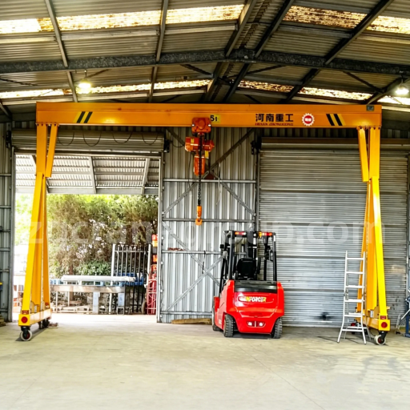
For plants that need to shift heavy rolls, die sets, or tooling between multiple points on the floor — receiving to storage, storage to the press line, press line to finishing — a portable gantry crane is often the most practical answer. Because it requires no foundation or ceiling-mounted structure, it can be positioned wherever the job is, then rolled out of the way when it isn’t needed. This matters in converting and print plants where floor layouts shift as product lines change and permanent structural lifting points are rarely available everywhere they’re needed.
A portable gantry also scales well: smaller units handle roll changes and tooling moves at a single workstation, while larger capacity models can be specified for heavier substrate rolls or bulkier die sets, without the lead time or disruption of installing fixed infrastructure.
3.2 Jib Cranes for Fast Cylinder Changes at the Press
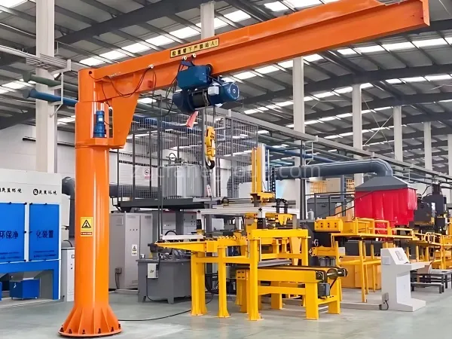
Cylinder and anilox roll changes happen at a fixed location — the press itself — and they happen often. For this kind of repetitive, workstation-level lift, a jib crane is typically the better fit than a mobile unit. Mounted to a wall, column, or floor base beside the press, a jib crane gives operators a repeatable, controlled path to lift and rotate a cylinder into exact position, reducing both changeover time and the risk of surface damage that comes with manual handling.
Because jib cranes rotate through an arc rather than traveling the length of a bay, they’re well suited to the tight, fixed-footprint spaces around press lines, where a gantry’s larger travel path isn’t needed and floor space is already at a premium.
3.3 When a Fixed Overhead Crane or Hoist Makes More Sense
For very high-volume operations — continuous roll handling at scale, or facilities already built around a structural runway — a fixed overhead bridge crane or monorail hoist system may still be the more efficient long-term investment. The trade-off is upfront cost and installation downtime, which is why many mid-sized packaging and printing operations start with portable or workstation-level equipment and only move to a fixed system once volume justifies it.
4. Matching the Equipment to the Job: A Quick Selection Checklist
| Factor | Favors Portable Gantry | Favors Jib Crane | Favors Fixed Overhead Crane |
|---|---|---|---|
| Load location | Multiple points across the floor | Single fixed workstation | Continuous coverage of a bay |
| Load weight | Medium-to-heavy rolls, dies | Medium cylinders, tooling | High-volume, heavy continuous loads |
| Frequency | Occasional moves, changing layouts | Frequent, repetitive changeovers | Constant, high-throughput lifting |
| Floor space | Needs clearance to reposition | Tight, fixed footprint | Dedicated structural bay |
| Capital budget | Low-to-moderate | Low-to-moderate | Higher, with installation lead time |
Running the actual numbers — weight, frequency, and available space — against this checklist will usually point to one clear category before a single quote is requested.
5. Safety and Load-Rating Basics
Whichever equipment is chosen, the fundamentals don’t change. Every lift should stay within the equipment’s rated capacity, with margin — never load to the limit as a matter of routine. Slings, hooks, and shackles used for rolls and cylinders should be inspected before each shift and rated specifically for the load shape being handled, since a rounded cylinder and a palletized roll put different stresses on rigging. Equipment itself should go through scheduled inspection, and operators should be trained specifically on the loads they’re lifting, not just on general crane operation. These basics are inexpensive compared to the cost of a single serious incident or a damaged cylinder.
6. FAQ
What lifting capacity do packaging plants typically need? Most roll, cylinder, and die-handling tasks in packaging and printing fall between 500 kg and 3 tons, though very large substrate rolls can exceed this. Capacity should always be sized to the heaviest expected load, not the average one.
Do portable gantry cranes need a foundation? No — this is their main advantage over fixed systems. They’re designed to be freestanding and repositioned as needed, which is why they suit plants with changing layouts or multiple handling points.
How do I lift a print cylinder without damaging it? Use rigging designed for cylindrical loads, lift at designated journal or trunnion points rather than the printing surface, and use equipment that allows controlled, low-speed positioning — which is exactly what a workstation-mounted jib crane is built for.
Can one gantry crane serve multiple workstations? Yes, provided it’s rated for the heaviest load it will handle and the floor layout allows it to be rolled between points without obstruction.
What’s the difference between a jib crane and a gantry crane? A jib crane is fixed to a wall, column, or base and lifts through a rotating arc at one location. A gantry crane is a freestanding, often mobile structure that can travel along a floor path, making it suited to moving loads between multiple points rather than lifting repeatedly at one station.
Solving material handling in a packaging or printing plant starts with an honest look at three variables: how much weight is being moved, how often, and across how much space. Once those numbers are clear, matching equipment to the job is straightforward — a portable gantry crane for rolls and tooling that travel across the floor, a jib crane for fast, repeatable cylinder changes at the press, and a fixed overhead system only once volume truly demands it. For most mid-sized operations, the right combination of light and portable lifting equipment solves the problem without the cost or downtime of a permanent crane installation.