
Peel back any self-adhesive label, sticker, or strip of tape, and you’ll find three distinct layers doing three distinct jobs: the face stock you see and print on, the adhesive that holds it in place, and — hidden until you peel it away — the liner that let it stay rollable, stackable, and easy to apply in the first place. Two of those three layers depend almost entirely on silicone chemistry. If you’ve ever wondered why some labels peel off in one clean motion while others tear, leave residue, or refuse to let go at all, the answer is almost always buried in these two layers. Understanding them isn’t just a materials-science curiosity — it’s practical knowledge for anyone specifying, buying, or converting labels, stickers, and tape at scale.
1. The three-layer structure of every self-adhesive product
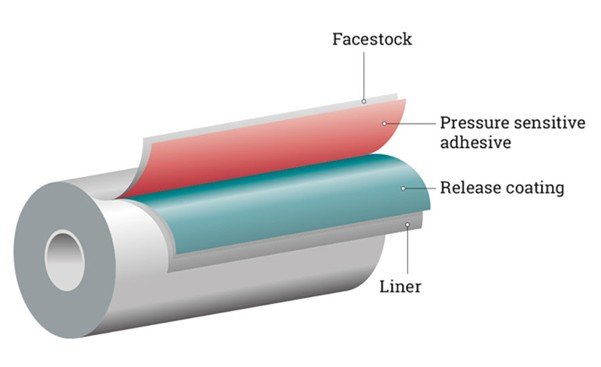
Nearly every self-adhesive product — whether it’s a shipping label, a branded sticker, a roll of packaging tape, or a laminate — is built from the same basic stack:
- Face stock: the visible layer, printed or plain, that carries the design, barcode, or branding. It can be paper, film, foil, or a laminate.
- Adhesive layer: the material that actually bonds the label or tape to a surface. This is where tack, peel strength, and removability are determined.
- Release liner (backing): a disposable carrier layer that protects the adhesive during storage and converting, and is peeled away at the point of application.
The face stock gets most of the design attention, but it’s the other two layers — the adhesive and the liner — that determine whether a label performs well in the field. Both of these layers rely heavily on silicone, for reasons that become clear once you look at what each one actually has to do.
2. Silicone release coatings: the non-stick backing that makes labels peelable
The release liner’s entire job is a contradiction: it has to let the adhesive stick firmly to it during storage and die-cutting, yet release that same adhesive cleanly and consistently the moment someone needs to apply the label. That balance — strong enough to protect, weak enough to release on demand — is almost impossible to achieve with an uncoated surface.
This is where a thin, even coating of silicone comes in. Silicone’s molecular structure gives it an unusually low surface energy, meaning very few other materials — including most pressure-sensitive adhesives — want to bond to it. A controlled layer of silicone release coating applied to paper or film liner creates a surface the adhesive can cling to just enough for handling, but not so much that it resists separation.
What makes silicone release coatings the dominant choice in the label and tape industry, rather than waxes or other non-stick treatments, comes down to a few practical advantages:
- Consistent release force across an entire production run, batch after batch, which matters enormously for automated labeling lines that can’t tolerate jams or skipped feeds.
- Tunable release levels — coatings can be formulated for “easy release” (light tack, fast-peeling labels) or “tight release” (used where liners must stay firmly attached until the last moment, such as in high-speed dispensing).
- Thermal and chemical stability, so the liner doesn’t degrade in hot warehouses, cold-chain storage, or humid shipping conditions.
- No migration into the adhesive, which keeps the bond strength of the PSA layer predictable over the liner’s shelf life.
Without a reliable release coating, the entire self-adhesive supply chain — from label converters to end users peeling a sticker off a backing sheet — simply wouldn’t function at the speed and consistency modern packaging demands.
3. Pressure-sensitive adhesives: what makes it stick — and unstick cleanly
The adhesive layer is where the real performance trade-offs happen. Pressure-sensitive adhesives (PSAs) are engineered to bond instantly under light hand or roller pressure, without needing heat, solvent, or water activation. That instant tack comes from a viscoelastic polymer structure that flows just enough to wet out a surface on contact, while remaining cohesive enough not to ooze or migrate.
Not all PSAs are built for the same outcome, and this is where “sticky” stops being a single property and becomes a spectrum:
- Permanent adhesives are formulated for maximum bond strength and are meant to stay put for the life of the product — think shipping labels, security seals, or branding on packaging that shouldn’t come loose in transit.
- Removable adhesives are tuned for lower peel strength so they can be lifted off cleanly, days or months later, without damaging the surface underneath or leaving behind adhesive residue — common in retail pricing labels, promotional stickers, or temporary signage.
- Repositionable adhesives sit at an even lighter tack level, allowing a label or note to be lifted and reapplied multiple times.
Silicone pressure-sensitive adhesive formulations occupy a distinctive niche within this spectrum. Built on polydimethylsiloxane (PDMS) backbones rather than acrylic or rubber-based polymers, silicone PSAs bring properties that are hard to replicate otherwise:
- Performance across extreme temperatures, holding bond strength from sub-zero cold storage through high-heat environments where acrylic adhesives soften or fail.
- Low surface energy adhesion, letting them bond to substrates — like silicone rubber, certain plastics, or low-energy films — that standard adhesives struggle to wet out at all.
- Long-term stability, resisting the oxidation and embrittlement that can cause other adhesives to yellow or lose tack over time.
- Clean release characteristics, which matter enormously for removable or repositionable applications where residue is unacceptable.
The adhesive and the release liner are, in effect, two sides of the same silicone-chemistry story: one layer is designed to make silicone adhere as little as possible, and the other is designed to make a silicone-based (or silicone-compatible) adhesive bond exactly as much as intended.
4. Why silicone is the material of choice
Across both layers, the recurring theme is control. Silicone’s defining trait — low, highly tunable surface energy — is precisely what label and tape manufacturers need, but it isn’t the only reason it dominates this space. Compared with older release and adhesive technologies, silicone systems offer:
- Wide temperature tolerance, remaining stable from deep-freeze to high-heat applications without cracking, softening, or losing release/adhesion consistency.
- Long-term chemical stability, resisting UV degradation, oxidation, and humidity far better than wax- or solvent-based alternatives.
- Minimal migration, meaning the release coating doesn’t bleed into the adhesive and compromise bond strength, and the adhesive doesn’t contaminate the face stock print.
- Process reliability at scale, since consistent molecular behavior translates directly into consistent machine performance on high-speed label and tape converting lines.
No single alternative technology matches silicone on all four fronts simultaneously, which is why it remains the default choice across the self-adhesive materials industry rather than a niche or premium option.
5. What this means when you’re buying labels and tape
For anyone sourcing labels, stickers, or tape — rather than formulating the materials themselves — the practical takeaway is simple: the liner and the adhesive deserve as much scrutiny as the printed face stock. A few questions worth asking before you commit to an order:
- What release level is the liner coated for? Easy-release liners suit manual application; tight-release liners are often necessary for high-speed automatic dispensing equipment.
- Is the adhesive permanent, removable, or repositionable? Matching this to the end-use environment avoids both premature peel-off and unwanted residue.
- Will the product face temperature extremes? Cold-chain packaging, outdoor signage, and high-heat industrial labeling all demand adhesives and liners rated for those conditions — not just generic PSA labels.
- Does the substrate have low surface energy? Plastics, coated films, and certain packaging materials may require silicone-specific adhesive formulations to achieve reliable adhesion at all.
- How consistent is the supplier’s coating process? Batch-to-batch variation in release force or tack is one of the most common (and avoidable) causes of label-application defects.
Asking a supplier directly about their liner’s release coating and their adhesive’s chemistry — rather than just its brand name or price — tends to surface exactly the information needed to avoid mismatches between the product and its application.
6. FAQ
What is a release liner and why is it silicone-coated? A release liner is the backing sheet that protects a label or tape’s adhesive before use. It’s coated with silicone because silicone’s low surface energy lets it hold the adhesive securely enough for storage and die-cutting, yet release it cleanly and consistently when the label is applied.
What’s the difference between removable and permanent adhesive? Permanent adhesives are formulated for maximum, long-term bond strength and aren’t meant to be peeled off without damage. Removable adhesives use a lighter tack profile designed to lift away cleanly, without residue, even after extended contact with a surface.
Why do some labels peel cleanly while others leave residue? Residue usually comes down to an adhesive formulated for permanent bonding being used where a removable one was needed, or an adhesive degrading over time due to heat, UV exposure, or chemical incompatibility with the surface. The liner’s release coating also plays a role, since inconsistent release can distort how the adhesive transfers during application.
Does silicone in the release liner contaminate the printed face stock? Properly formulated silicone release coatings are designed not to migrate, so they shouldn’t transfer into the adhesive or affect the face stock’s print quality. Migration issues typically point to a poorly cured or low-quality coating rather than an inherent flaw in silicone chemistry itself.
What should I ask a label supplier about their adhesive and liner? Ask what release level the liner is coated for (easy vs. tight release), whether the adhesive is permanent, removable, or repositionable, what temperature range it’s rated for, and whether it’s suited to the specific substrate you’re applying it to. These details matter more to real-world performance than the face stock material alone.
Choosing the right label, sticker, or tape ultimately comes down to choosing the right combination of release liner and adhesive — the two layers that silicone chemistry quietly governs. Get the release coating and the pressure-sensitive adhesive right, and the result is a product that applies smoothly, bonds reliably, and peels exactly the way it’s supposed to, whether that means staying put permanently or lifting away without a trace.