
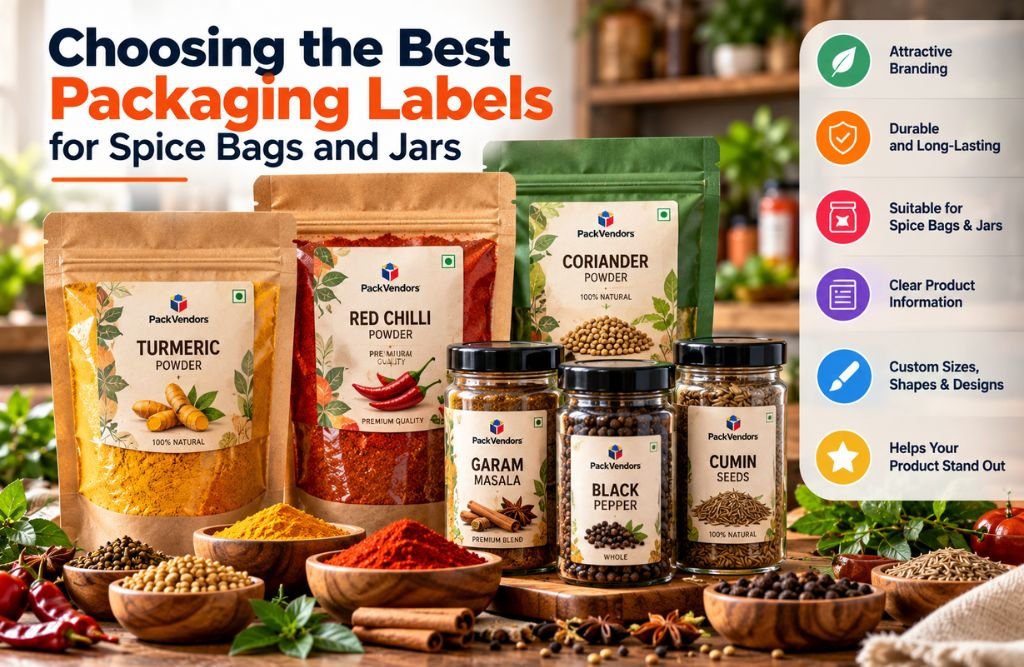
Walk into a grocery store and look at the spice section. Dozens of products compete for attention, from everyday turmeric and red chilli powder to premium garam masala, coriander powder, and blended seasonings. While the quality of the spices matters most, packaging is often the first thing customers notice.
A clear product name, attractive label, readable information, and suitable packaging can help a spice brand stand out on a crowded shelf. Whether you sell spices locally, supply retailers, or operate an online food business, choosing the right packaging labels is an important part of presenting your products professionally.
Custom spices bags and jar packaging labels allow businesses to display their brand identity, product details, and essential information across different packaging formats. The best choice depends on the packaging material, storage conditions, product range, and the appearance you want to create.
In this guide, we will explore how to choose suitable labels for spice bags and jars, what materials to consider, and which design details deserve attention before printing.
Why Packaging Labels Matter for Spice Brands
Spices are sold in many formats, including plastic pouches, stand-up zipper bags, kraft paper bags, glass jars, and plastic containers. Each format creates different labeling requirements.
For example, a small pouch of red chilli powder may need a compact label with a prominent product name, while a premium glass jar of mixed spices may benefit from a more detailed front label and a separate information label.
Well-planned spice labels can help your business:
-
Make the product name and spice variety easy to identify.
-
Maintain consistent branding across multiple products.
-
Present ingredients and other required product information clearly.
-
Give packaging a more organized, professional appearance.
-
Help customers distinguish between similar products and spice blends.
A label does not need an elaborate design to work effectively. Often, readable typography, a consistent color palette, and a well-organized layout are enough to create a strong impression.
How to Choose Labels for Spice Bags
Spice bags are popular because they are lightweight, easy to store, and available in different sizes. However, the label must suit the bag’s surface and construction.
1. Consider the bag material
Before selecting a label, identify whether the bag is made from paper, kraft material, plastic film, or a laminated packaging material. Smooth plastic and textured paper may require different adhesive solutions.
For example, a label designed for a paper pouch may not adhere equally well to a glossy plastic bag. If the packaging has a textured or coated surface, test the label on the actual material before ordering a large quantity.
2. Choose a suitable label size
A label should be large enough to display the product name, brand, and necessary information without overwhelming the package.
Small spice sachets generally need a compact layout, while larger stand-up pouches can accommodate more detailed designs. Leave sufficient space around the text so the label remains readable.
3. Think about how customers use the bag
Resealable zipper pouches are useful for customers who open and close the package several times. If the label sits near the zipper or a fold, make sure it does not interfere with opening, sealing, or handling the bag.
The label should also be positioned where it remains visible when the product stands on a shelf.
Choosing Labels for Spice Jars
Spice jars create a different design opportunity. Their shape, transparency, lid, and available labeling area all affect the final appearance.
Front labels for branding
The front label usually carries the brand name, spice variety, and other key product information. On a small jar, prioritize the most important details instead of trying to fit everything into one crowded design.
For transparent jars, a well-positioned label can make the product look organized while allowing customers to see the spice inside.
Side and back labels for product details
Depending on the jar size and applicable labeling requirements, a secondary label may be useful for ingredients, net quantity, manufacturer details, batch information, dates, and other required declarations.
Always confirm the applicable food-labeling requirements before finalizing the artwork.
Consider curved surfaces
Jars often have curved walls, which can affect how a label sits. A label that is too wide may wrinkle or lift at the edges. Measure the available surface and test the shape before printing.
For businesses comparing custom spices bags and jar packaging labels, the best design is one that fits the actual packaging rather than simply looking attractive in a digital mock-up.
Which Label Materials Are Suitable for Spice Packaging?
Material selection affects the label’s appearance, adhesion, and suitability for everyday handling.
| Label material | Potential application | What to consider |
|---|---|---|
| Paper labels | Many indoor spice jars and selected packaging formats | Moisture exposure and surface compatibility |
| Synthetic labels | Selected plastic bags and jars | Confirm adhesive and material compatibility |
| Transparent labels | Clear jars and minimalist packaging | Text contrast against the spice and background |
| Textured or premium-finish labels | Gift packs and premium spice ranges | Readability, cost, and suitability for the packaging surface |
| Kraft-style labels | Rustic or traditional product presentation | Adhesion to the actual paper or kraft surface |
No material is automatically suitable for every spice product. Moisture, oil residue, temperature changes, handling, and the packaging surface can influence performance.
If your products are stored in humid conditions or handled frequently, ask your printer about suitable material and adhesive combinations. Testing a sample on the finished package is a sensible step before bulk printing.
Design Tips for Attractive Spice Packaging Labels
A good spice label helps customers identify the product quickly. The design should reflect your brand while keeping essential information easy to read.
Use colors consistently
Color can help distinguish product varieties. For example, your brand might use one color for turmeric, another for chilli powder, and a third for coriander powder.
The shades do not have to represent the actual spice perfectly. What matters is maintaining a consistent visual system so customers can recognize your product range.
Make the product name prominent
A customer should not need to search for the words “Turmeric Powder,” “Black Pepper,” or “Garam Masala.” Give the product name enough space and contrast to remain readable on the finished package.
Keep the brand identity consistent
Use the same logo, typography style, and general layout across your spice bags and jars. You can change product colors and details without redesigning the entire label for every variety.
Check the final printed size
Small text can look readable on a computer but become difficult to read after printing. Review the artwork at its actual size, especially if the label includes ingredients, batch numbers, or barcodes.
What Information Should a Spice Label Include?
The required information depends on the product, packaging, and applicable regulations. Before printing, verify the current requirements for your business and product category.
Depending on the applicable rules, a packaged spice label may need details such as:
-
Product name and spice variety
-
Ingredient information, where applicable
-
Net quantity
-
Manufacturer or packer details
-
Batch or lot identification
-
Manufacturing or packing date and applicable date marking
-
Relevant storage instructions
-
Applicable food registration or licence details
-
MRP and other required declarations
-
Barcode, if used for retail or inventory management
For products sold in India, check the applicable FSSAI food-labeling requirements and Legal Metrology declarations. Do not assume that a decorative front label alone satisfies all requirements.
If you use a barcode, make sure it has adequate contrast and can be scanned after printing. Proofread every detail before approving the final artwork.
What Affects Spice Label Printing Costs?
The cost of printed labels depends on more than the number of labels ordered. Understanding the main factors helps you request an accurate quotation.
Common cost factors include label dimensions, order quantity, material, printing method, shape, adhesive, finish, and artwork preparation. Roll labels and sheet labels may also have different production requirements.
For example, a small batch of premium transparent jar labels may have different costs from a large order of standard paper labels for spice pouches.
When requesting a quotation, provide:
-
The bag or jar dimensions.
-
The label size and preferred shape.
-
The required quantity.
-
The packaging material and surface.
-
Your artwork or design reference.
-
Any special material, adhesive, or finishing requirements.
If you sell several spice varieties, consider planning the entire product range together. Consistent label dimensions and layouts may simplify production, although the actual savings depend on the specifications and order quantities.
Common Spice Label Printing Mistakes to Avoid
Even an attractive design can cause problems if practical details are overlooked.
-
Choosing the wrong adhesive: A label may peel if it is unsuitable for the bag or jar surface.
-
Overcrowding the design: Too much text can make the product name difficult to notice.
-
Ignoring curved surfaces: Labels that are too wide may wrinkle or lift on jars.
-
Using poor contrast: Light text on a similar background can become difficult to read.
-
Skipping a physical proof: Colors, dimensions, and readability should be checked before bulk printing.
-
Forgetting product variations: Each spice variety needs accurate product details and the correct label artwork.
A final review should cover spelling, product names, dimensions, regulatory details, material, adhesive, and label placement.
Where to Get Custom Spice Packaging Labels
If you are launching a spice brand or updating existing packaging, start by deciding whether you need labels for pouches, jars, or both. Share the packaging samples, approximate dimensions, product range, and expected quantity with your printing supplier.
For businesses looking for custom spices bags and jar packaging labels, discussing the actual application before printing can help identify suitable materials, label sizes, and finishing options.
PackVendors can be considered for custom packaging and label printing requirements. Confirm the available materials, printing options, minimum order quantities, and production timelines before placing an order.
Frequently Asked Questions
Can the same label design be used for spice bags and jars?
The same branding system can be used across both formats, but label dimensions and layouts may need to change. A curved jar and a flat pouch have different surface requirements.
Are transparent labels suitable for spice jars?
They can work well on clear jars when the text contrasts sufficiently with the spice inside. Test the finished label with the actual product to ensure readability.
How can I prevent spice labels from peeling?
Choose a compatible adhesive, prepare a clean application surface, and test the label on the actual packaging. Moisture, oil residue, surface coatings, and handling can affect adhesion.
What should I provide when ordering custom labels?
Provide the packaging type, dimensions, quantity, artwork, required information, and intended storage conditions. These details help the printer recommend suitable options.
Can labels be customized for different spice varieties?
Yes. A consistent design can be adapted for turmeric, chilli powder, coriander, cumin, garam masala, and other products by changing the product name, colors, and relevant details.
Conclusion
Choosing suitable labels for spice bags and jars involves balancing appearance, readability, material compatibility, and practical packaging requirements. A clear product name, consistent branding, suitable adhesive, and carefully checked artwork can help your products look professional and remain easy to identify.
Whether you sell everyday spices or premium blends, plan your labels around the actual packaging and the information customers need. Test the design and material before placing a large order, and confirm all applicable labeling requirements.
With thoughtful design and suitable printing specifications, your spice packaging can communicate your brand clearly while giving customers a better shopping experience.