
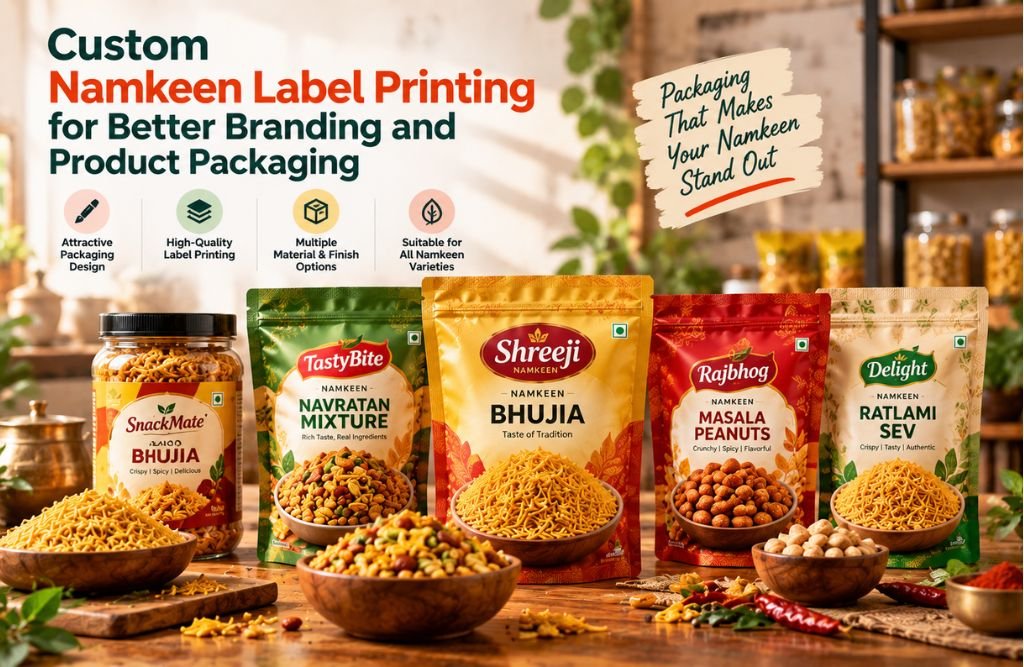
Walk into any grocery store and you will find dozens of namkeen packets competing for attention. Sev, bhujia, mixture, dalmoth, masala peanuts, chana and other snacks may sit side by side, often in similar-sized packets. In that situation, packaging becomes an important part of the customer’s first impression.
A good namkeen package should do more than use bright colors. It should make the brand recognizable, show the product clearly, provide important information and look attractive enough to encourage customers to take a closer look.
This is where thoughtful namkeen packaging design and professionally printed labels can make a difference. Whether you are starting a small snack business or managing an established namkeen brand, the right combination of design, material, size and printing can give your products a more consistent identity.
For businesses developing new packaging, Namkeen Label Printing can turn an approved design into a practical printed label that is ready for your actual product packaging.
Why Namkeen Packaging Matters for Your Brand
Customers often make a quick judgment when they see a product for the first time. They may notice the brand name, product image, colors and overall appearance before reading the smaller details.
A well-planned package can help customers quickly understand:
- What the product is
- Which brand makes it
- Which flavor or variety it contains
- What makes the product different
- How much product is inside
- Where to find important product information
For example, a packet of spicy masala peanuts could use a bold visual style, while a traditional bhujia brand may prefer a more familiar and traditional appearance. A premium dry-fruit mixture might benefit from a cleaner, more refined presentation.
The goal is not to make every package look complicated. The goal is to make it recognizable, readable and relevant to the product.
What Makes Effective Namkeen Packaging Design?
Good packaging starts with the product rather than the graphics.
Before choosing colors or creating artwork, consider who buys the product, where it will be sold and how customers will see it.
A strong namkeen packaging design usually balances three important elements:
1. Strong Brand Identity
Your logo, brand name and visual style should be easy to recognize. If you have several products, maintaining common branding elements can help customers understand that they belong to the same company.
2. Clear Product Identification
The product name should be visible without requiring customers to search through the design.
For example:
Classic Bhujia
Masala Peanuts
Punjabi Mixture
Spicy Sev
The product name should have enough visual importance to compete with photographs and decorative elements.
3. Attractive Product Presentation
Food photography, illustrations and colors can make a snack look more appealing. However, these elements should support the product instead of hiding the brand name or important information.
How to Choose Colors for Namkeen Packaging
Color is one of the quickest ways to create a recognizable product range.
You don’t necessarily need to use the brightest possible colors. Instead, choose colors that fit your brand and make different products easy to distinguish.
For example:
- Traditional namkeen can use warm or familiar colors.
- Spicy snacks can use bold, energetic colors.
- Premium products may benefit from a more restrained palette.
- Health-focused snacks can use natural or earthy tones.
- Different flavors can use different accent colors.
If you sell five varieties of namkeen, you could keep the logo, typography and basic layout consistent while changing the accent color for each product.
This creates a recognizable product family without making every packet look identical.
Make Your Product Name Easy to Notice
A common packaging mistake is allowing decorative elements to become more prominent than the actual product.
Imagine a customer looking at a shelf from several feet away. Can they immediately understand whether the packet contains sev, bhujia or mixture?
The product name should be readable at the actual printed size.
Food images should support that message. If you are selling masala peanuts, for example, the image should make the product obvious rather than simply filling empty space.
A clean visual hierarchy can work well:
Brand → Product Name → Flavor/Variant → Supporting Information
This helps customers understand the package quickly.
Namkeen Packaging Options: Labels vs. Printed Pouches
Not every business needs the same type of packaging.
Custom Labels
Labels can be useful when businesses want flexibility in branding or need stickers for jars, containers, boxes or pouches.
They can also be practical for businesses offering multiple products or making smaller production runs.
Printed Pouches
Directly printed pouches can provide an integrated packaging appearance and may be suitable for larger-scale production.
However, the right option depends on production quantity, packaging format, artwork requirements and budget.
For a business that frequently changes products, quantities or designs, custom labels may offer useful flexibility.
Choosing the Right Material for Namkeen Labels
The label material should match the actual packaging and storage environment.
Paper Labels
Paper can be suitable for applications where significant moisture exposure is not expected. It can work well with appropriate boxes, jars and other packaging surfaces.
Synthetic Labels
Synthetic materials may be considered where greater resistance to moisture or handling is required.
Transparent Labels
Clear labels can create a modern appearance on suitable bottles, jars and containers. However, the color of the packaging behind the label can affect how the artwork looks.
Specialty or Textured Labels
For premium products, specialty materials or textured finishes can give the packaging a distinctive appearance.
When planning namkeen packaging design, consider the actual packaging surface rather than designing only for a computer screen.
Choosing the Right Label Size and Shape
The label needs to fit the packaging properly.
Before finalizing dimensions, check:
- Width and height of the available surface
- Flat or curved packaging
- Space around the logo
- Product information requirements
- Label application method
- Corners and edges
- Whether the label needs to wrap around the container
A label that looks perfectly balanced on a computer can appear too large or too small once applied to the actual package.
For curved jars or containers, testing the label on the real packaging before bulk production can help identify sizing problems.
Matte vs. Glossy Namkeen Labels
The finish can change how customers perceive the packaging.
Glossy Finish
Glossy labels can make colors look brighter and can work particularly well with colorful food photography.
Matte Finish
Matte labels provide a softer, less reflective appearance and can work well with minimalist or premium designs.
Neither option is automatically better. The choice should match your design, packaging material, brand personality and intended use.
What Information Should a Namkeen Label Include?
An attractive label still needs to communicate important product information.
Depending on the product and applicable requirements, the packaging may include information such as:
- Brand name
- Product name
- Ingredients
- Net quantity
- Nutritional information
- Batch information
- Date-related information
- Storage instructions
- Manufacturer or business details
- Customer care information
- Other applicable food-label information
The exact requirements can vary according to the product and applicable regulations. Review the final artwork carefully before sending it for production.
Choosing the Right Adhesive
Adhesive is easy to overlook until a label starts peeling or fails to stick properly.
The appropriate adhesive can depend on the packaging surface and environment.
Consider whether the label will be applied to:
- Plastic
- Glass
- Cardboard
- Paper
- Metal
- Smooth surfaces
- Slightly textured surfaces
Moisture, temperature, handling and surface conditions can also affect label performance.
If you are unsure, explain how and where the product will be stored before finalizing the label material and adhesive.
Roll Labels or Sheet Labels?
The application method can influence how labels should be supplied.
Sheet labels can be convenient for smaller orders and manual application.
Roll labels can be useful when labels are applied repeatedly or used with labeling equipment.
If you use a semi-automatic or automatic labeling machine, provide the printer with the equipment requirements before production. Details such as roll direction, spacing, core size and label dimensions may need to match the machine.
Professional Namkeen Label Printing should therefore be planned around both the packaging and the way the labels will be applied.
What Affects Namkeen Label Printing Cost?
There isn’t one fixed price for every label because several factors influence production cost.
These can include:
- Label dimensions
- Quantity
- Material
- Shape
- Printing requirements
- Adhesive
- Finish
- Cutting requirements
- Roll or sheet format
- Special finishing
A small quantity with a specialty material may have very different production costs from a large quantity of standard labels.
Instead of choosing an option based only on the lowest price, consider whether the label will perform properly and represent your brand well.
Manual vs. Machine Label Application
A business applying a few hundred labels manually may have different requirements from a manufacturer applying thousands of labels with equipment.
Manual Application
Manual application can offer flexibility for small or medium businesses. Operators can position labels directly on jars, boxes or other packaging.
Machine Application
Machine application requires greater consistency. Label size, spacing, roll format and winding direction may become important.
If you plan to move from manual application to machine application as your business grows, it is worth discussing the change with your printing provider before placing a large order.
Common Namkeen Packaging Mistakes to Avoid
Using Too Much Information
A crowded package can make important information difficult to find. Keep the layout organized.
Making the Brand Too Small
Customers should be able to identify your brand without searching for the logo.
Using Poor-Quality Images
A blurry food image can make otherwise good packaging look unprofessional.
Copying Competitor Designs
Your packaging should give customers a reason to remember your brand rather than looking like another version of an existing product.
Ignoring the Actual Packaging
Always check the label size and shape against the real packet, jar or container.
Skipping the Proof
A physical proof can reveal color, sizing, spelling or alignment issues before a larger production run.
Before You Approve Your Namkeen Labels
Use this simple checklist before production:
- Product name is clearly visible
- Brand logo is correctly positioned
- Spelling has been checked
- Label dimensions are correct
- Packaging surface has been considered
- Food images are high quality
- Required information has been reviewed
- Material is suitable for the application
- Adhesive has been considered
- Finish matches the design
- Roll or sheet format is correct
- Sample or proof has been checked
This small review can prevent expensive corrections later.
How to Build a Consistent Namkeen Product Range
If you sell several products, don’t design every packet from scratch.
Instead, create a common visual system.
For example, keep the following consistent:
- Logo placement
- Brand colors
- Typography
- Basic layout
- Illustration style
Then change:
- Product name
- Product photograph
- Flavor
- Accent color
- Variant information
This makes it easier for customers to recognize your brand while shopping for different products.
Frequently Asked Questions
What is important in namkeen packaging design?
A strong design should combine recognizable branding, a clear product name, attractive food visuals, readable information and packaging-specific requirements.
Can I use the same design for different namkeen products?
Yes. A consistent design system can be used across different products while changing the product name, image, flavor and accent colors.
Should I choose matte or glossy labels?
Both can work. Glossy finishes can suit vibrant designs, while matte finishes can create a softer or more premium appearance. The best choice depends on your packaging and brand style.
Can I order custom-shaped namkeen labels?
Custom shapes may be possible depending on the printing and cutting method, material and production requirements.
Should I check a sample before bulk printing?
Yes. A sample can help you check the label size, color, readability, alignment and appearance on the actual packaging before approving a larger order.
Can namkeen labels be supplied on rolls?
Yes, roll labels can be suitable for repeated manual application or labeling machines. Machine requirements should be discussed before production.
Create Packaging Customers Can Recognize
Namkeen packaging doesn’t need to be complicated to stand out. A strong product name, recognizable branding, appetizing visuals and a well-organized layout can make the package easier for customers to understand and remember.
The printing process is equally important. The right material, adhesive, finish, dimensions and application format help turn the design into a label that works on the actual product.
Whether you are launching a new snack brand or updating an existing product range, Namkeen Label Printing can be an important part of creating consistent packaging.
With thoughtful namkeen packaging design, businesses can build a product range that looks connected while still giving each variety its own identity. The result is packaging that not only looks attractive but also communicates clearly and represents the brand every time a customer sees it.