
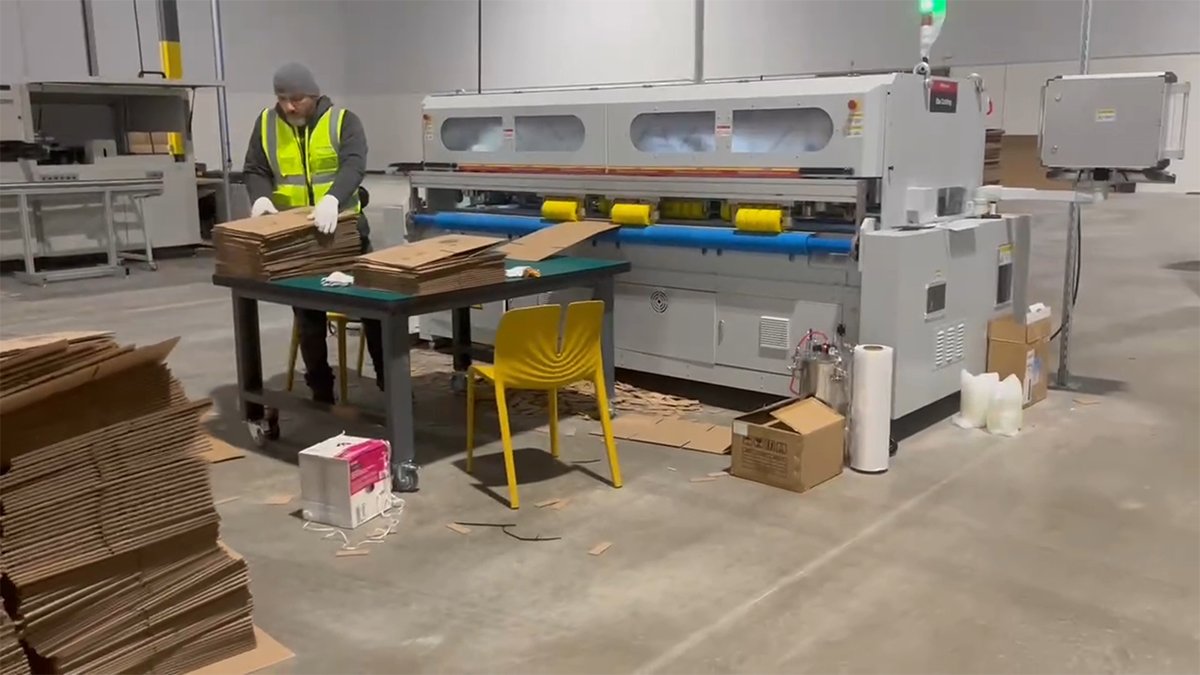
Why Short Runs Challenge Conventional Corrugated Workflows
Corrugated converters increasingly face a production mix that is difficult to serve with one traditional process. Long repeat orders still reward dedicated tooling and high-speed equipment, but many customers now request smaller batches, custom dimensions, frequent design changes, and shorter lead times. The challenge is not whether these boxes can be produced; it is whether they can be produced economically without adding unnecessary setup, tooling, and material-handling steps.
Conventional die cutting remains highly efficient for stable, high-volume work. Once a die has been prepared and the job is established, repeatability and throughput can be excellent. The economics become less attractive when order quantities fall and structural variety rises. Every new design may require different tooling, and the cost of making, storing, retrieving, and changing dies becomes harder to spread across a small batch.
Digital cutting tables solve a different problem. They are extremely flexible for samples, prototypes, and very small quantities, but they are not always the best fit when a converter must move from a handful of samples to recurring commercial orders of dozens or hundreds of boxes. Between high-volume die cutting and sample-oriented digital cutting is a growing middle ground where a box making machine can provide a practical production option.
A Texas Converter Needed More Flexibility
A packaging converter in Hutchins, Texas, added a corrugated box making machine in 2025 to expand its ability to handle customized structures. The machine was configured with vibrating knife cutting, creasing tools, and an integrated cold-glue function so that a wider range of box designs could be processed within one production workflow.
The production requirement is familiar to many packaging companies: customers want boxes that are dimensionally specific, produced in relatively small batches, and sometimes structurally different from standard regular slotted cartons. Some orders may include locking features, handle openings, curves, cut-outs, or other non-linear elements that would normally require dedicated die tooling or an additional cutting step.
For this type of order mix, the value of a box making machine comes from reducing the number of separate processes required to turn a sheet of corrugated board into a finished or near-finished blank.
What a Box Making Machine Changes
A modern box making machine can combine several operations that would otherwise be handled separately. Depending on the configuration, these operations can include feeding, creasing, slotting, slitting, cross-cutting, irregular cutting, and gluing.
One practical example is a box making machine that brings these functions into a single integrated workflow. Instead of preparing a dedicated tool for every size change, operators can select a box style, enter the required dimensions, and let the machine adjust for the next order.
For short-run production, changeover time matters as much as maximum running speed. A machine that can switch efficiently between different dimensions and structures can help a converter process a broader order mix without turning every small batch into a tooling project.
This does not mean every job should be routed through the same machine. The important point is that box making equipment adds another production option. It gives planners a way to separate jobs by economic profile instead of forcing high-volume equipment to handle work for which it was not designed.
Why Integrated Converting Matters
Production efficiency is rarely determined by one operation in isolation. A fast cutting process may offer limited benefit if the blank then has to be moved through several manual or semi-automatic stations before it becomes usable. Short runs make this especially visible because stopping, stacking, identifying, moving, and restarting small batches can represent a significant share of total job time.
In the Texas installation, the ability to combine standard corrugated converting with irregular cutting and cold-glue application was important because it reduced handoffs between separate processes. The objective was not simply to make one cut faster; it was to shorten the overall path from flat board to completed blank.
This is one reason packaging companies should evaluate equipment as part of a workflow rather than as a list of individual specifications. Feeding method, job setup, changeover, waste removal, finished-board handling, and downstream labor all influence the real output of a short-run department.
Where Vibrating Knife Cutting Fits
Vibrating knife cutting extends the range of structures that can be produced without a dedicated physical die. Curved cuts, circles, rectangles, angled features, and other irregular paths can be created from programmed geometry or imported design data, depending on the job and machine configuration.
Its strongest application is not necessarily the highest-volume repeat order. Instead, it is most useful when designs change frequently, quantities are moderate, and the cost or delay of creating dedicated tooling would be disproportionate to the size of the order.
That makes vibrating knife capability complementary to the core box-making process. Straight slotting, slitting, creasing, and cross-cutting still perform most of the work on many corrugated designs, while the knife is used when a job requires features that cannot be created efficiently with standard straight-line tools.
When Conventional Die Cutting Is Still the Better Choice
Box making machines should not be presented as a universal replacement for rotary or flatbed die cutting. For stable box designs that run in large quantities over long periods, conventional die cutting remains difficult to beat. Once tooling is prepared, high-volume die-cutting equipment can deliver excellent throughput and repeatability.
The most practical strategy is often hybrid. Long repeat runs remain on dedicated die-cutting equipment. Prototypes and one-off development jobs may stay on a digital cutting table. Short and medium runs with frequent dimensional or structural variation can be routed to box making equipment.
This approach protects the capacity of high-speed equipment while giving production teams a flexible route for jobs that fall between sampling and mass production.
A Practical Evaluation Checklist
Before investing in a box making machine, converters should study their actual order history rather than relying only on a machine demonstration. Useful questions include:
- How many jobs each month require a new or modified cutting die?
- What percentage of orders are short or medium runs rather than long repeats?
- How often do customers change dimensions after the first production order?
- Which structures require curves, holes, locking features, or irregular cutting paths?
- How much time is spent moving work between cutting, creasing, gluing, and finishing stations?
- What board thicknesses and flute combinations must be processed consistently?
- How important is fast job changeover compared with maximum speed on one repeated SKU?
- Can operators manage digital job files and maintain consistent setup standards across shifts?
From Machine Choice to Order-Mix Strategy
The Texas project illustrates why the discussion around box making equipment should begin with the order mix rather than the machine brochure. A converter handling only a few stable SKUs will calculate value differently from a plant serving many customers with custom dimensions and unpredictable batch sizes.
As corrugated packaging becomes more customized, production systems need to absorb variability without turning every small order into a tooling project. Box making equipment does not remove the need for conventional converting assets. Instead, it gives production managers another routing option for jobs that require flexibility, moderate throughput, and rapid changeover.
For many packaging plants, that additional routing option is the real advantage. It allows the production method to fit the order rather than forcing the order to fit the production method.