
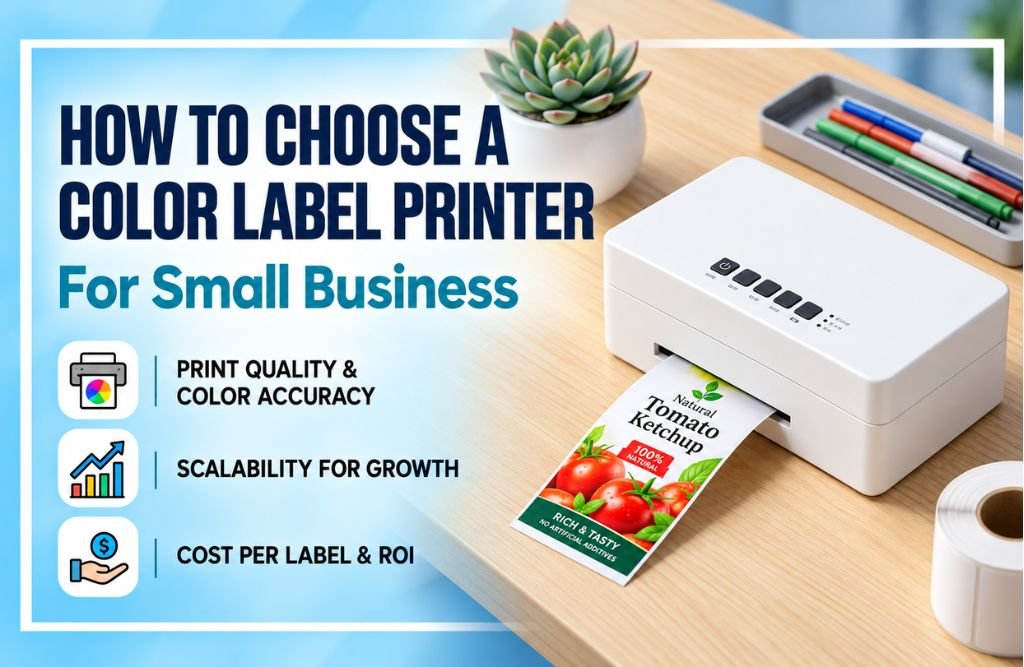
For small businesses selling packaged products, labels are more than simple identification tools. They communicate brand identity, display product information, and help products stand out on crowded shelves. Whether you sell handmade cosmetics, specialty foods, candles, beverages, or personalised gifts, professional-looking labels can influence how customers perceive your products.
Investing in a full color label printer for small business can make packaging more flexible and reduce dependence on external printing suppliers. Instead of ordering large quantities of pre-printed labels, businesses can produce labels in-house, update designs, and print only what they need.
However, choosing the right printer requires understanding printing technologies, material compatibility, operating costs, and expected production volumes.
Why Small Businesses Need a Color Label Printer
Outsourcing label printing is convenient for businesses with stable designs and predictable order quantities. However, it can become less practical when product information changes frequently or multiple packaging variations are required.
An in-house color label printer offers several advantages.
Flexible Small-Batch Label Printing
Small businesses often produce limited quantities of products, particularly during market testing or seasonal promotions.
A digital color label printer allows companies to print smaller batches without committing to large inventories of pre-printed labels.
This flexibility is useful for businesses introducing new flavours, fragrances, packaging sizes, or product variations.
Faster Product Launches
When labels are printed internally, businesses can update artwork and produce packaging labels without waiting for external printing schedules.
This can shorten preparation time for new products, promotional campaigns, and limited-edition releases.
More Control Over Branding
Consistent branding helps customers recognise products across different packaging formats.
With suitable label design software, businesses can adjust logos, colours, text, and product information while maintaining a consistent visual identity.
Reduced Label Waste
Printing labels according to actual demand can help minimise unused inventory, particularly when product designs or regulatory information change.
However, the overall cost savings depend on consumables, printing volume, and equipment maintenance.
Types of Color Label Printers for Small Businesses
Not all label printers use the same technology. Understanding their differences is important before purchasing equipment.
1. Inkjet Color Label Printers
Inkjet printers use liquid ink to produce text, graphics, photographs, and full-colour designs.
They are commonly used for food packaging, cosmetics, beverages, and promotional labels.
Advantages:
Suitable for detailed graphics and colour gradients
Supports short-run customised printing
Available in different print widths and production capacities
Compatible with various specially coated label materials
Limitations:
Ink and maintenance costs vary by model
Some printers require specific coated media
Water and abrasion resistance depend on ink and label materials
Inkjet printing is often a practical choice for businesses prioritising colourful packaging and detailed artwork.
2. Color Laser Label Printers
Laser printers use toner and heat to produce printed images.
They can be useful for businesses requiring colour labels alongside general office printing.
Advantages:
Produces sharp text and graphics
Toner does not dry out like liquid ink
Suitable for compatible sheet-fed label materials
Limitations:
Media must tolerate the printer’s fusing temperature
Some models have limited support for continuous label rolls
Adhesive labels must be approved for laser printing
Color laser printers may suit businesses producing relatively small quantities of sheet-based labels.
3. Thermal Transfer Label Printers
Thermal transfer printers use heat and a ribbon to transfer text or graphics onto compatible label materials.
Most conventional thermal transfer label printers produce single-colour output per printing pass rather than full-colour photographic designs.
They are widely used for barcodes, product identification, shipping labels, and industrial applications.
For businesses requiring durable variable information rather than colourful graphics, thermal transfer printing can be a practical alternative.
What to Consider When Choosing a Color Label Printer
Printing Resolution and Quality
Print resolution affects the clarity of small text, logos, and detailed graphics.
Many commercial label printers offer resolutions around 300 DPI or higher, although actual image quality also depends on the printing technology, ink, media, and print settings.
Businesses producing detailed product labels should request sample prints before purchasing.
Label Size and Material Compatibility
Check the maximum printing width and supported media types.
Common label materials include:
Matte and glossy paper
Synthetic films such as polypropylene and polyester
Waterproof label materials
Transparent adhesive films
Specially coated packaging labels
Not every printer supports every material. Inkjet, laser, and thermal transfer technologies have different media requirements.
Printing Speed and Production Volume
A small business printing 100 labels per week has different requirements from a company producing several thousand labels daily.
Consider the number of labels required per production run, how frequently designs change, and whether printing will become part of a continuous packaging process.
A faster printer may reduce production time, but it may also require a larger investment.
Ink, Toner, and Maintenance Costs
The purchase price represents only part of the total cost.
Businesses should evaluate consumable expenses, printhead replacement, maintenance requirements, label materials, and expected equipment lifespan.
A useful comparison is the estimated cost per finished label, including printing materials and operational expenses.
Software and Connectivity
A suitable printer should work with the business’s preferred label design software and operating systems.
Depending on the model, connectivity options may include USB, Ethernet, Wi-Fi, or Bluetooth.
Businesses planning automated production should also consider integration with inventory management, barcode generation, and packaging systems.
Color Label Printer vs. Outsourced Label Printing
Should a small business invest in its own printer or continue purchasing printed labels?
| Factor | In-House Color Label Printer | Outsourced Label Printing |
| Initial cost | Equipment investment required | Usually lower |
| Small-batch printing | Flexible | May involve minimum orders |
| Design changes | Can be made internally | Require supplier coordination |
| Production lead time | Generally shorter | Depends on supplier |
| Large-volume orders | Depends on printer capacity | Often more economical |
| Maintenance | Managed internally | Managed by supplier |
| Inventory control | Print according to demand | May require bulk purchasing |
For businesses with frequently changing designs and relatively small production volumes, in-house printing offers greater flexibility.
For large quantities of identical labels, outsourcing may provide better economies of scale.
Which Small Businesses Benefit Most?
A color label printer for small business can support a wide range of applications.
Food and beverage producers can print labels for coffee, tea, sauces, snacks, and specialty drinks.
Cosmetics manufacturers can create customised labels for skincare products, soaps, fragrances, and personal care items.
Candle and gift businesses can produce seasonal packaging, personalised messages, and limited-edition designs.
Small retailers and online sellers can print branded product labels and promotional stickers according to changing inventory requirements.
Packaging and printing service providers can also use digital label printers to handle short-run customer orders.
Masung Group: Printing Solutions for Product Identification and Packaging
Established in 2006, Masung Group is a China-based custom printer manufacturer specialising in thermal printing technologies, industrial label printers, and customised printing solutions.
Its product portfolio includes thermal transfer label printers, barcode printers, embedded printing modules, and specialised equipment for packaging and product identification.
While conventional Masung thermal transfer printers are not direct substitutes for full-colour inkjet label printers, they can complement colour packaging workflows by printing variable information such as barcodes, serial numbers, batch codes, and product identification labels.
Masung also provides OEM and ODM services for customers requiring customised printing equipment, software integration, or application-specific modifications.
Businesses evaluating label printing solutions can contact Masung’s engineering team to discuss printing materials, label dimensions, production requirements, and equipment compatibility.
Conclusion
Choosing the best color label printer depends on the products being labelled, the required print quality, production volume, and available budget.
Inkjet printers are often suitable for colourful product packaging, while laser printers can support compatible sheet-based labels. Thermal transfer printers remain useful for durable identification labels and variable data printing.
Before investing, businesses should compare sample quality, material compatibility, consumable costs, and long-term production requirements.
The right printing solution should support current packaging needs while providing enough flexibility for future product development.