
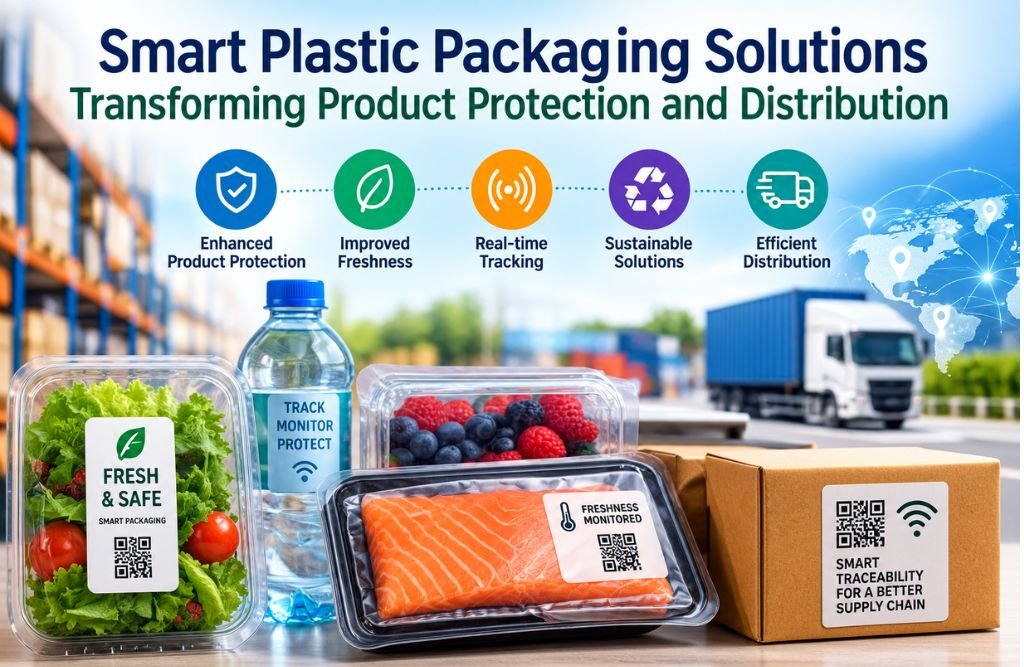
Packaging has grown to become more than just a crucial component in storage and protection of products. Advances in material science, sensing technologies, electronic labelling and coding, automation and analysis have paved way for the invention of innovative smart plastic packaging systems, whose purpose is to make the products visible, maintain their quality, reduce any losses and optimize logistics procedures.
The change is occurring within the overall plastic packaging industry, where companies producing packaging materials have to balance such factors as durability, lightweight design, product protection, recycling potential, price, and manufacturability. Simultaneously, changes within the flexible packaging industry open up a whole new range of possibilities for smart films, pouches, sachets, wraps, and multi-layered constructions.
What Makes Plastic Packaging Smart?
The conventional function of packaging is mainly focused on the physical roles like containing, protecting, handling, and transporting products. The smart packaging brings information, detection, communication, and protection capabilities to the packaging in relation to the product conditions or providing further information on the packaged product. The smart packaging may be broadly classified under two major classes: intelligent packaging and active packaging.
Key Technologies Are as Follows:
Marker Technology: Time-temperature marker, freshness marker, gas marker, and moisture marker provide information regarding the state of the product.
Digital Marking Technology: QR code, NFC tag, RFID technology, and serial marking provide assistance in linking physical packages with digital information regarding the product.
Active Technology: Oxygen scavenger, moisture scavenger, antimicrobial and controlled release technologies provide assistance in product preservation.
Security Technology: Seals, films, label, and closures provide physical evidence of any tampering done by anyone.
Track and Trace Systems: Connected markers help to track products in manufacturing, storage, transportation, and distribution stages.
This technological fusion makes packaging transform from a mere physical protective layer to a form of communication within the logistics process.
How Smart Packaging Enhances Product Protection and Quality
Smart packaging is extending the role of plastic packaging beyond basic containment and physical protection. Monitoring, preservation, and functional technologies provide greater visibility into product conditions while supporting quality throughout storage, transportation, and distribution.
Product Protection Becomes More Data-Driven
One of the major benefits of smart packaging is the opportunity to assess the parameters that could not have been detected before during the transportation and storing process. Parameters such as temperature, humidity, oxygen, light exposure, package condition, and duration of the transportation process affect the quality of many goods, especially foods, beverages, pharmaceuticals, and some other industrial products. Temperature-sensitive goods can serve as an example in this case. While a traditional package can secure goods from any physical damages, it cannot say anything about the temperature at which these goods were transported.
Active Packaging Extends the Protective Function
Active packaging is related to quality maintenance, not quality monitoring of the product. The additive functions incorporated into the films, trays, containers, closures, and inserts are designed to act within the packaging environment, affecting the quality parameters of the product degradation process. Control of moisture content is yet another use of active packaging. Next up is the development of antimicrobial packaging technology. The application of antimicrobial agents in the packaging material aims to prevent any microorganism activity at the product/package interface. Nevertheless, there are many criteria of this technique’s success.
Digital Technologies Improve Packaging Traceability
Technological advancements have enhanced the correlation between physical packaging and digital supply chains. Technology for identifying, tracking and sharing information has enabled more visibility along the process of goods transportation, stock and distribution.
Digital Identification Reshapes Distribution
Digital identification is becoming an increasingly important aspect of modern-day packaging. With the use of QR Codes, RFID, NFC technology and serial numbering, digital identification is being built into every package, case, pallet or batch of products. Digital traceability is particularly useful in cases where complex logistics are involved. The more processing plants involved in the supply chain process, the more important it is to have an efficient system linking the physical to the digital.
Smart Packaging in Food and Beverage Distribution
One of the most significant applications is food and beverages since packaging can affect the freshness of the goods, their shelf-life, protection against contamination and efficient transportation. Smart packaging systems also allow to monitor all of these features. Freshness sensors serve to indicate any changes that are caused by the spoilage of the food products. In accordance with different types of technologies, the sensors can react to gases, the change of pH level, the presence of microorganisms and other chemicals.
Pharmaceutical Packaging Gains Greater Intelligence
There are tough guidelines when it comes to pharmaceutical distribution. The aspects that include identity, integrity, storage, and traceability can be met with the help of smart plastic packaging through temperature tracking, serial numbering, tamper evident packaging, and digital authentication. Temperature-sensitive cold chain pharmaceuticals are very vulnerable to temperature fluctuations. Indicators and monitors give more information about whether these products have been within the set parameters throughout transit and storage.
Smart Packaging Responds to E-Commerce and Manufacturing Changes
Changes in e-commerce distribution and packaging manufacturing are creating new requirements for package-level information and operational efficiency. Smart packaging technologies support automated handling, inspection, identification, and tracking across increasingly complex distribution networks.
E-Commerce Creates New Packaging Requirements
The emergence of e-commerce has brought about changes to how goods are transported through distribution channels. Goods are increasingly being shipped through automation centers, postal systems, regional warehouses, and last mile deliveries before reaching customers. However, smart packaging solutions present possible solutions to these issues. Digital identification enables sorting and inventory tracking, while tamper-proof structure provides extra details regarding the package integrity. Packaging information also contributes to logistics optimization.
Automation Accelerates Smart Packaging Adoption
The process of producing the packaging has also been increasingly mechanized. Printing at a high speed, digital coding, machine vision, robot handling, automated inspection, and serialization are some techniques that enable intelligence to be built in the mass manufacturing processes. Machine vision is quite essential when it comes to quality control. Another advantage of digital printing is that it makes provision for variability of the information printed. Packaging manufacturers can create unique codes, batch numbers, promotional codes or product information without the need to make changes in the entire printing plate system.
Regulatory and Safety Considerations
In the case of smart packaging, there arise issues relating to regulation that go beyond those involved in traditional packaging. Functional substances, active ingredients, inks, coatings, adhesives, sensors, and indicators may have to be tested in addition to the type of application and jurisdiction involved. Food packaging should be noted due to the direct or indirect interaction between the materials and the food. Pharmaceutical packaging has its own high standards when it comes to the compatibility of the product, contamination, integrity, and traceability.
Smart Packaging and the Flexible Packaging Market
The flexible packaging market plays an ever-growing role in the progress of smart packaging since flexible films and pouches allow for printing large amounts of codes, sensors, indicators, and functional layers. Light-weighting features of such materials also contribute to better logistics compared to certain types of rigid packaging.
Flexible designs may have multiple functions packed into one package. In case of multilayer films, for instance, there will be mechanical properties, moisture protection, oxygen barrier properties, heat sealing ability, printability, and a smart property, but not in addition to another packaging element. The problem here is that the design aspect should consider the lifecycle of the package as well as its functionality.
How Economic and Consumer Factors Shape Adoption
Adoption of smart packaging depends on packaging cost, product value, size of production, and the kind of consumer interface needed. These aspects determine the appropriateness of the smart characteristics in different product sectors.
Economics of Smart Plastic Packaging
Cost remains a key element in the use of intelligent packaging. Traditional packaging typically uses cost-effective manufacturing processes for high volume and relatively stable input costs. The use of sensors, electronics, special coatings, or active materials adds additional costs that must be balanced against real benefits gained from their use. Manufacturing efficiencies for sensors, printed electronics, digital identification, and functional films can improve as the scale of manufacturing increases.
The Role of Consumer Interaction
The technology of smart packaging also affects how the customer interacts with the product inside the package. The package with QR codes can present information on the product, cooking instructions, how to recycle it, authenticate the product, and keep digital record of the product through a smartphone.
This results in creating yet another medium of communication between the brand and retailer as well as the customer. However, compared to printed information on packaging that remains unchanged for a long time, digital information may always be updated. However, usefulness depends on how easy it is to use.
Supply-Chain Visibility Becomes More Important
The current distribution channels include more than one supplier, warehouse, carrier, retailer, and point of fulfillment. Increased visibility of product movement allows for identification of the source of delay, damage, temperature excursion, and inventory issues. Smart packaging is an interface for product identification with a digital supply chain system.
This strategy is also helpful in inventory control since increased accuracy in identification will allow for better tracking of inventory, decreased need for manual entry, and distinction of individual batches within the larger inventory. For some industries, this is important due to the direct relationship of traceability with quality management.
Outlook for the Packaging Industry
Future innovations within smart plastic packaging will be more focused on combinations rather than a singular technology. For instance, barrier properties, light weighting, digital markers, active systems, security systems, and environment detection will be incorporated into packaging according to application needs.
However, the flexible packaging industry has been built around lightweight and high-performance structures that allow for intelligent printing and functional layering. In addition, material recovery challenges continue to face the industry. Research from companies like Pristine Market Insights focuses on packaging from an integrated point of view considering aspects such as material technology, product protection, supply chain needs, sustainability, manufacturing automation, and regulation among others.
Smart Packaging Evolves from Protection to Intelligent Product Management
Intelligent plastic packaging market has shifted the role of packaging from being just a protective shield to an intelligent element in product management and distribution. Intelligent indicators, active elements, digital tagging, anti-tampering features, sensor-based technology and traceability technology have opened new horizons for the monitoring of products and increased visibility through ever-complicated product value chains.
The future development in the area will probably revolve around integration and application-oriented design. Manufacturers of packaging materials, packaging producers, technology providers, manufacturers, logistics providers, and even regulators are more and more aligned in pursuing the same goal: protection of the products while utilizing resources and information systems effectively.