
Anyone who has worked a full shift on a packaging line or in a distribution warehouse knows the truth by lunchtime: it’s not the boxes that wear you out, it’s your feet. Ten or twelve hours on concrete, moving between stations, climbing in and out of trucks, standing at a conveyor — all of that adds up fast if your footwear isn’t built for it.
Most buying guides for this kind of work jump straight into steel toes and safety ratings. This one doesn’t. Instead, it focuses on the three things that actually determine whether a boot survives a full shift and keeps your feet in good shape: comfort, durability, and fit. Those are the factors that separate a boot you forget you’re wearing from one you’re peeling off your feet by 3 p.m.
What Makes a Long Packaging or Warehouse Shift Hard on Your Feet
Packaging and fulfillment environments are uniquely tough on footwear for a few specific reasons.
First, there’s the floor itself. Warehouse and plant floors are almost always poured concrete — a surface with zero natural give. Unlike dirt, grass, or carpet, concrete sends every bit of impact straight back up through your heel and into your joints. Over a full shift, that repeated shock is what leads to sore arches, tired calves, and lower back fatigue.
Second, there’s the movement pattern. Packaging and warehouse roles rarely involve sitting. You’re on your feet almost constantly, shifting between standing at a station, walking the floor, and occasional quick bursts of activity — lifting, reaching, turning. That mix of static standing and short-distance walking is harder on feet than steady walking alone, because your muscles never settle into one consistent motion.
Third, many packaging environments have wash-down areas, spill zones, or humid corners near loading docks — not constant water exposure, but enough dampness that footwear materials matter.
Put those three factors together — hard flooring, mixed movement, occasional moisture — and you get a clear picture of what to prioritize: how the sole is built, how much room the toe box gives your foot, how easy the boot is to get on and off between breaks, and whether the upper holds up in damp conditions. Let’s go through each one.
Comfort First: Sole Construction and Toe Room
If there’s one upgrade that makes the biggest difference on a concrete floor, it’s the sole. A boot with a cushioned, shock-absorbing midsole does the job your own arches can’t do for ten hours straight — it absorbs the impact before it reaches your joints. Look for a wedge or layered sole design rather than a thin, flat one; wedge soles tend to distribute weight more evenly across the whole foot instead of concentrating pressure on the heel.
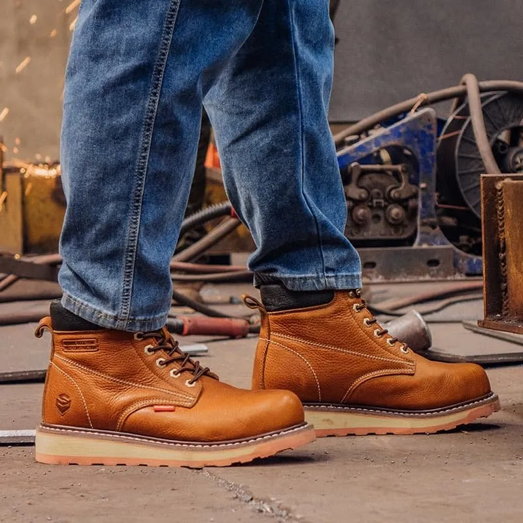
Toe room matters just as much, and it’s the detail people overlook most often. A tight, narrow toe box might feel fine for the first hour of a shift, but after eight or ten hours of standing and walking, cramped toes lead to numbness, blisters, and that dull ache that makes the last hour of a shift feel endless. A rounder, roomier toe shape gives your foot space to move and swell naturally over the course of a long day — which is exactly why moc toe styles are popular on packaging and warehouse floors. The moccasin-style construction typically pairs a wider, softer toe box with a flexible, cushioned sole, making it one of the more comfortable options for people who are on their feet all day rather than walking long distances outdoors. You can browse that style directly in this moc toe work boots collection if you want to compare options built around that wider, all-day-comfort shape.
Easy On/Off for Shift Work
Anyone working rotating or split shifts knows the small frustrations add up: lacing up before clocking in, unlacing for a break, relacing again before you’re back on the floor. Multiply that by every shift, every week, and it’s real time and real annoyance.
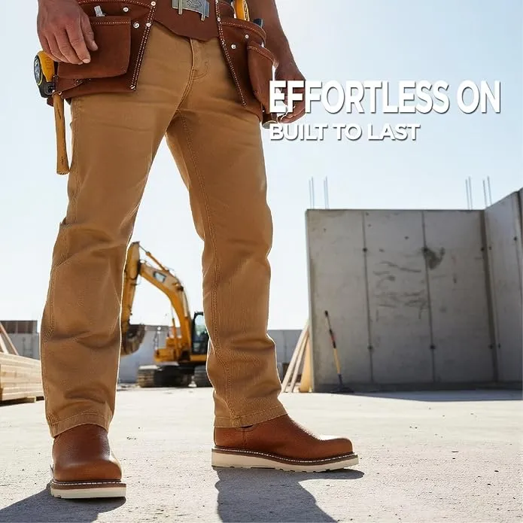
This is where slip-on and pull-on styles earn their place in a packaging or warehouse setting. A well-made slip-on boot uses elastic side panels or a snug pull-tab design to hold your foot securely without needing laces at all, which means you can get boots on and off in seconds — useful for quick breaks, locker room changes, or simply getting out the door faster before an early shift. The trade-off people sometimes worry about is fit security, but a properly sized slip-on with a supportive ankle collar holds just as snugly as a laced boot once it’s on; you’re not sacrificing stability, just the fiddly process of tying and untying. If quick changes between tasks or shifts are part of your routine, it’s worth comparing options in this slip-on work boots collection to see which pull-on style fits your foot shape best.
Waterproof Options for Wash-Down and Wet Zones
Not every packaging job involves standing water, but plenty involve the occasional wet patch — a spill near a filling station, condensation near refrigerated storage, or a damp loading dock on a rainy morning. Boots with a waterproof or water-resistant upper simply handle those moments better. A treated leather or sealed-seam upper keeps moisture from soaking through and reaching your socks, which matters more than people expect: damp feet inside a boot for hours is one of the fastest ways to develop blisters and discomfort, even in an otherwise climate-controlled building.
If your facility has any wash-down areas, outdoor loading sections, or seasonal dampness, it’s worth choosing a boot with a water-resistant upper as a baseline feature — not because of any formal rating, but simply because dry feet are more comfortable feet, shift after shift.
A Quick Checklist Before You Buy
Before adding a pair to your cart, run through this short list:
- True-to-size fit — order in your usual size first, but check the brand’s sizing notes, since toe box width varies between moc toe and round toe styles.
- Break-in expectations — leather boots typically need a few short shifts to fully mold to your foot; don’t judge comfort after day one alone.
- Sole cushioning — press your thumb into the insole area; a sole with some give will absorb more impact than a hard, flat one.
- Upper material — look for treated or water-resistant leather if your area has any damp zones.
- Closure style that matches your routine — laced for maximum adjustability, slip-on for speed between breaks and shifts.
FAQ
How do I know if my boots are the right size for a 10-hour shift?
Try them on later in the day if possible, since feet naturally swell slightly during long periods of standing. You want about a thumb’s width of space at the toe and a snug, not tight, fit through the midfoot.
What’s the difference between moc toe and round toe for comfort?
Moc toe boots generally have a wider, softer front section, giving toes more room to move throughout a long shift. Round toe styles are more structured and tend to suit people who prefer a snugger, more traditional fit.
Are slip-on boots secure enough for warehouse work?
Yes, when properly sized. Quality slip-on boots use elastic panels and a supportive collar to keep your foot stable without laces, making them a practical choice for fast-paced shift environments.
How long should work boots last in a packaging plant?
With regular wear on concrete floors, a well-made pair typically lasts between six months and a year before the sole cushioning noticeably breaks down, though this varies with shift length and how often they’re rotated with a second pair.
Do I need waterproof boots if I work mostly indoors?
Not strictly, but a water-resistant upper is a low-cost insurance policy against spills, wash-down areas, and damp loading docks — situations that come up more often than most indoor workers expect.
When you’re on your feet for an entire shift, the boot that wins isn’t the one with the most features — it’s the one that gets the basics right: a cushioned sole that handles concrete, a toe box that gives your foot room to breathe, a closure style that fits your routine, and an upper that shrugs off the occasional wet spot. Get those fundamentals in place first, and the rest of your shift gets noticeably easier.