
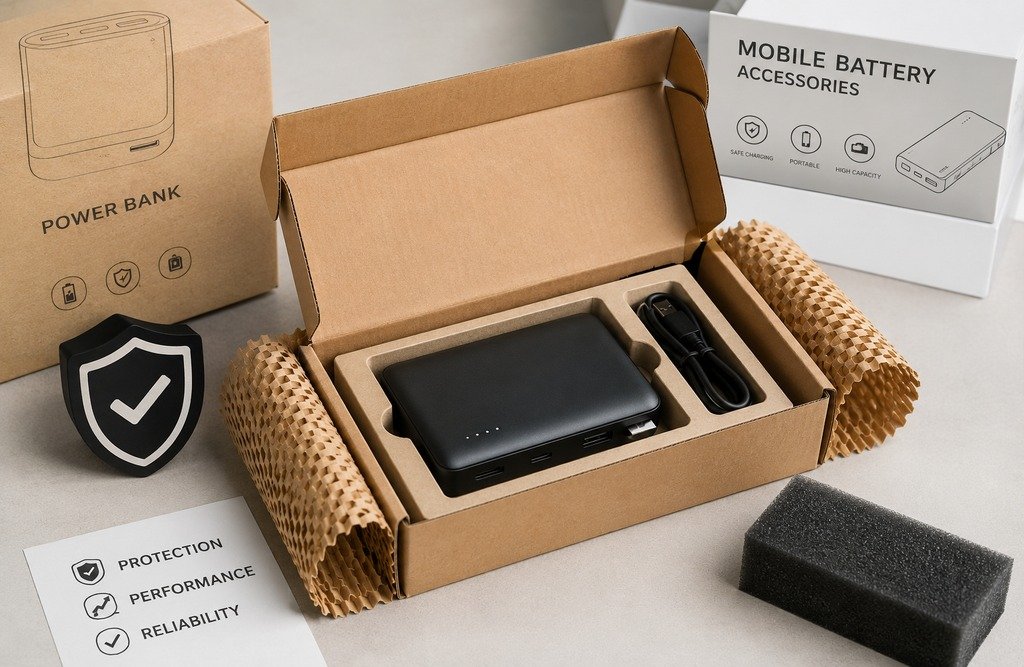
Mobile battery accessories have become an everyday part of modern technology. Power banks, portable battery packs, charging accessories, and related electronic products help people stay connected when they are away from a wall outlet. But while these products are designed to deliver portable power, they still need appropriate protection before they reach the customer.
A mobile battery pack can be exposed to impacts, vibration, pressure, moisture, and repeated handling during shipping. Even when the electronic device itself is manufactured to high standards, inadequate packaging can increase the risk of damage before it reaches its destination.
This makes protective packaging an important consideration for manufacturers, retailers, and e-commerce businesses selling mobile battery packaging.
Why Mobile Battery Accessories Need Protective Packaging
Electronic accessories are generally more sensitive to transportation conditions than many ordinary consumer products.
A package can be dropped during handling, compressed underneath heavier shipments, or exposed to continuous vibration while traveling in a delivery vehicle. If the product moves excessively inside the box, these conditions can put unnecessary stress on its casing, ports, buttons, cables, and other components.
Battery-powered products deserve additional attention because physical damage can affect both the appearance and functionality of the product.
Protective packaging helps create a controlled environment around the accessory, reducing unnecessary movement and providing a barrier between the product and external handling conditions.
The Right Box Size Can Make a Difference
One of the simplest packaging mistakes is using a box that is much larger than the product.
Extra space allows a mobile battery pack to move around inside the package. During transportation, that movement can result in repeated impacts against the sides of the box.
A properly sized package can reduce this problem.
The objective is not to make the box as small as possible. Instead, there should be enough room for appropriate protective material while keeping the product securely positioned.
This becomes especially useful for businesses shipping different battery pack sizes. Rather than using one oversized box for every product, packaging can be designed around the dimensions of each product.
Inserts Help Keep Battery Accessories Secure
Internal inserts can provide another layer of protection.
A well-designed insert creates a dedicated space for the product and can prevent it from moving around during transportation. It can also separate the main battery pack from charging cables, adapters, manuals, or other accessories included in the package.
This organization has two benefits.
First, it helps protect the components. Second, it creates a cleaner unboxing experience when the customer opens the package.
For electronic products, inserts can be made from materials selected according to the product’s protection requirements. Custom corrugated inserts, for example, can be designed around product dimensions and can help hold items securely during transportation.
Cushioning Helps Absorb Transportation Impacts
Even when a product fits well inside its box, additional cushioning may sometimes be necessary.
Cushioning materials help absorb some of the energy created when a package experiences an impact. The appropriate solution depends on the product’s weight, shape, fragility, and shipping conditions.
For mobile battery accessories, protective structures may be used around vulnerable areas while keeping the product firmly positioned.
Foam inserts can be particularly useful for products that require a more precise fit. They can be manufactured with custom cavities designed around individual products, helping reduce movement and providing shock absorption.
The important thing is to avoid simply filling the package with excessive material. Protection should come from thoughtful packaging design rather than unnecessary bulk.
Packaging Should Protect Ports, Buttons, and Accessories
A mobile battery pack is more than its outer casing.
Charging ports, buttons, cables, connectors, and other small components can also be vulnerable during transportation.
If accessories are allowed to move freely inside a package, they may rub against the main product or place pressure on sensitive areas.
A well-organized package can give each component its own space.
For example, a power bank can be secured in the center of an insert while a charging cable is held in a separate compartment. This keeps the contents organized and reduces the chance of components colliding with one another.
Anti-Static Considerations for Electronics
Some electronic components can be sensitive to electrostatic discharge, depending on their design and internal circuitry.
Businesses shipping electronic products should therefore consider whether their products require anti-static packaging materials or handling procedures.
The packaging should be selected according to the product’s actual technical requirements rather than assuming that every electronic accessory needs exactly the same protection.
For manufacturers and retailers, consulting packaging and electronics specialists can help determine the appropriate materials for a particular product.
Moisture Protection Can Matter During Shipping
Packages do not always travel through controlled environments.
During transportation and storage, products may encounter humidity, condensation, or accidental exposure to moisture.
Although the outer shipping box provides a basic barrier, businesses may need additional protection depending on the product, shipping route, climate, and storage conditions.
Moisture-resistant packaging components or appropriate protective bags can provide an additional layer of security when required.
Again, the right solution depends on the actual shipping environment.
Strong Outer Packaging Provides Structural Protection
Internal protection is only one part of the packaging system.
The outer box needs enough structural strength to handle normal transportation and stacking conditions.
A weak outer package may collapse under pressure, leaving the product inside vulnerable to impact.
Corrugated packaging is commonly used for shipping because its layered structure can provide strength while remaining relatively lightweight.
The appropriate board grade and box construction should be selected according to the product’s weight and transportation requirements.
Protective Packaging Can Also Improve the Unboxing Experience
Protection and presentation do not have to be separate goals.
A package can protect a mobile battery accessory while also creating a clean and professional experience for the customer.
Organized compartments, fitted inserts, clear product placement, and carefully designed packaging can make the unboxing process easier.
For technology brands, this matters because packaging is often the first physical interaction a customer has with a product after purchasing it online.
A package that arrives intact and looks thoughtfully organized can reinforce the impression of product quality.
Custom Packaging Can Support Different Battery Products
Mobile battery accessories come in many shapes and sizes.
A compact power bank may require a very different package from a larger portable power station or a multi-accessory charging kit.
Using the same packaging structure for every product can create unnecessary empty space or inadequate protection.
Custom packaging boxes allow businesses to adapt the box dimensions and internal structure to the specific product.
For brands that need packaging built around their electronic products, mobile battery packaging can provide a product-specific packaging option designed around the requirements of battery-related accessories.
This approach can help businesses combine product protection, efficient sizing, and professional presentation rather than relying entirely on generic boxes.
Test Packaging Before Shipping at Scale
Before launching a new packaging design, businesses should test it under realistic conditions.
A package may look secure when sitting on a desk but behave differently when transported through a delivery network.
Testing can include:
- Checking how much the product moves inside the box
- Inspecting the box after controlled drops
- Evaluating compression resistance
- Checking whether inserts remain in place
- Inspecting ports and accessories for potential contact damage
- Reviewing the package after simulated transportation
Testing can reveal weaknesses before hundreds or thousands of products are shipped.
If the product moves too much, the solution may be a redesigned insert rather than simply adding more cushioning.
Right-Sized Packaging Can Reduce Shipping Waste
Protective packaging should not automatically mean oversized packaging.
An unnecessarily large package requires more material and may occupy additional space during transportation. It can also require more filler to keep the product from moving.
Right-sized packaging can help businesses find a better balance between protection and efficiency.
For e-commerce companies shipping large numbers of mobile battery accessories, small improvements in package dimensions can become significant over time.
Less wasted space can mean more efficient storage, packing, and transportation.
Sustainable Packaging Is Becoming More Important
Consumers are increasingly paying attention to the environmental impact of packaging.
For technology companies, this creates an opportunity to rethink how electronic accessories are packaged.
Using recyclable materials, right-sized boxes, efficient inserts, and reduced unnecessary filler can help businesses minimize packaging waste while still protecting the product.
Sustainable packaging does not mean sacrificing protection.
The goal is to use materials intelligently and only where they serve a useful purpose.
Packaging Is Part of the Product Experience
A mobile battery accessory may be small, but its packaging has several important jobs.
It needs to protect the product during transportation, keep accessories organized, withstand normal handling, and present the product professionally when it reaches the customer.
This is why packaging should be considered during the product development and fulfillment process rather than as an afterthought.
When the box dimensions, inserts, cushioning, materials, and shipping conditions are considered together, businesses can create a more reliable packaging system.
Conclusion
Mobile battery accessories are designed to make modern technology more convenient, but getting these products safely into customers’ hands requires more than reliable electronics.
Packaging plays an important role in protecting power banks, charging accessories, cables, and related products throughout their journey.
The right combination of box size, structural strength, internal inserts, cushioning, and moisture or anti-static considerations can reduce transportation risks while creating a better customer experience.
For technology brands and e-commerce businesses, the best packaging is not necessarily the biggest or most heavily protected package. It is the package that provides the right level of protection while using materials and space efficiently.
FAQ’s
Why is protective packaging important for mobile battery accessories?
Protective packaging helps reduce product movement and shields battery accessories from impacts, vibration, compression, moisture, and other transportation-related risks.
Are custom boxes better than standard boxes for power banks?
Custom boxes can provide a better fit around the product and reduce unnecessary empty space. They can also accommodate custom inserts and dedicated compartments for accessories.
Do mobile battery packs need inserts?
Not every product requires an insert, but inserts can be useful for keeping battery packs, charging cables, adapters, and other components securely separated during transportation.
How can packaging reduce damage during shipping?
Properly sized boxes, protective inserts, cushioning, and strong outer packaging can work together to reduce movement and absorb some of the forces a package experiences during transportation.
Should battery accessory packaging be tested?
Yes. Testing can help identify weaknesses before products are shipped at scale. Businesses can evaluate box strength, product movement, insert performance, and protection under simulated transportation conditions.